


Page 324 - Encyclopedia of Aquarium and Pond Fish, 3rd Edition
P. 324
322    POND FISH:  ILLNESS AND TREATMENT

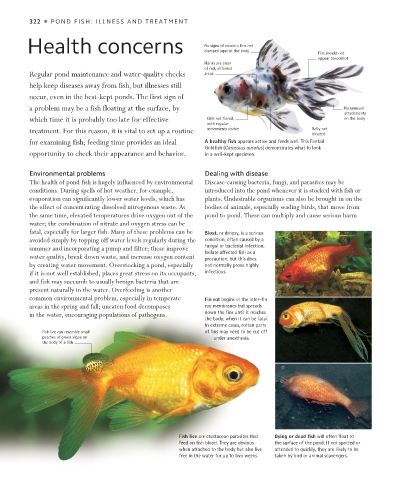
         Health concerns                                 No signs of erosion; fins not
                                                         clamped against the body
                                                                                         Fins should not
                                                                                         appear bloodshot
                                                         Flanks are clear
                                                         of red, inflamed
         Regular pond maintenance and water-quality checks   areas
         help keep diseases away from fish, but illnesses still
         occur, even in the best-kept ponds. The first sign of
         a problem may be a fish floating at the surface, by                                    No unusual
                                                                                                attachments
         which time it is probably too late for effective   Gills not flared,                   on the body
                                                          with regular
         treatment. For this reason, it is vital to set up a routine   movements visible  Belly not
                                                                                       bloated
         for examining fish; feeding time provides an ideal   A healthy fish appears active and feeds well. This Fantail
                                                         Goldfish (Carassius auratus) demonstrates what to look
         opportunity to check their appearance and behavior.  in a well-kept specimen.

         Environmental problems                          Dealing with disease
         The health of pond fish is hugely influenced by environmental   Disease-causing bacteria, fungi, and parasites may be
         conditions. During spells of hot weather, for example,   introduced into the pond whenever it is stocked with fish or
         evaporation can significantly lower water levels, which has    plants. Undesirable organisms can also be brought in on the
         the effect of concentrating dissolved nitrogenous waste. At    bodies of animals, especially wading birds, that move from
         the same time, elevated temperatures drive oxygen out of the   pond to pond. These can multiply and cause serious harm
         water; the combination of nitrate and oxygen stress can be
         fatal, especially for larger fish. Many of these problems can be   Bloat, or dropsy, is a serious
         avoided simply by topping off water levels regularly during the   condition, often caused by a
         summer and incorporating a pump and filter; these improve   fungal or bacterial infection.
         water quality, break down waste, and increase oxygen content   Isolate affected fish as a
                                                         precaution, but this does
         by creating water movement. Overstocking a pond, especially   not normally prove highly
         if it is not well established, places great stress on its occupants,   infectious.
         and fish may succumb to usually benign bacteria that are
         present naturally in the water. Overfeeding is another
         common environmental problem, especially in temperate    Fin rot begins in the inter-fin
         areas in the spring and fall; uneaten food decomposes    ray membranes but spreads
         in the water, encouraging populations of pathogens.   down the fins until it reaches
                                                         the body, when it can be fatal.
                                                         In extreme cases, rotten parts
             Fish lice can resemble small                of fins may need to be cut off
             patches of green algae on                      under anesthesia.
             the body of a fish


                                                  Fish lice are crustacean parasites that   Dying or dead fish will often float to
                                                  feed on fish blood. They are obvious   the surface of the pond. If not spotted or
                                                  when attached to the body but also live   attended to quickly, they are likely to be
                                                  free in the water for up to two weeks.    taken by bird or animal scavengers.


   US_322-325_Illness_Breeding_Ch.indd   322                                                         29/08/18   4:11 PM

