


Page 35 - Encyclopedia of Aquarium and Pond Fish, 3rd Edition
P. 35
LIGHTING AND HEATING    33


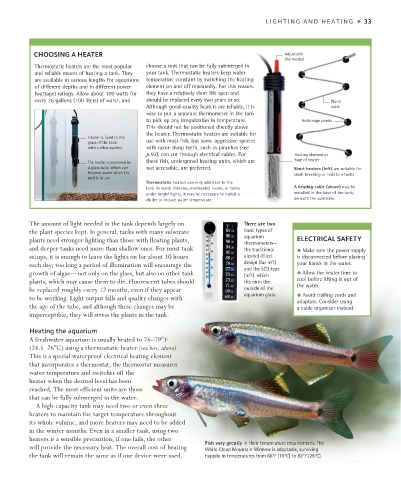
          CHOOSING A HEATER                                                    Adjustable
                                                                               thermostat
           Thermostatic heaters are the most popular   choose a unit that can be fully submerged in
           and reliable means of heating a tank. They   your tank. Thermostatic heaters keep water
           are available in various lengths for aquariums   temperature constant by switching the heating
           of different depths and in different power   element on and off repeatedly. For this reason,
           (wattage) ratings. Allow about 100 watts for   they have a relatively short life span and
           every 26 gallons (100 liters) of water, and   should be replaced every two years or so.   Warm
                                         Although good-quality heaters are reliable, it is   cable
                                         wise to put a separate thermometer in the tank
                                         to pick up any irregularities in temperature.   Anchorage points
                                         This should not be positioned directly above
                                         the heater. Thermostatic heaters are suitable for
                         Heater is fixed to the
                         glass of the tank   use with most fish, but some aggressive species
                         with rubber suckers  with razor-sharp teeth, such as piranhas (see
                                         p.92), can cut through electrical cables. For   Heating element at
                         The heater is enclosed in   these fish, undergravel heating units, which are   base of heater
                         a glass tube, which can   not accessible, are preferred.  Short heaters (left) are suitable for
                         become warm when the                                     small breeding or isolation tanks.
                         unit is in use
                                         Thermostatic heaters can only add heat to the
                                         tank. In warm climates, overheated rooms, or tanks   A heating cable (above) may be
                                         under bright lights, it may be necessary to install a   installed in the base of the tank,
                                         chiller to reduce water temperature.     beneath the substrate.

         The amount of light needed in the tank depends largely on    There are two
         the plant species kept. In general, tanks with many substrate   basic types of
         plants need stronger lighting than those with floating plants,   aquarium   ELECTRICAL SAFETY
                                                                    thermometers—
         and deeper tanks need more than shallow ones. For most tank   the traditional   •  Make sure the power supply
         setups, it is enough to leave the lights on for about 10 hours   alcohol-filled   is disconnected before placing
         each day; too long a period of illumination will encourage the   design (far left)   your hands in the water.
         growth of algae—not only on the glass, but also on other tank   and the LCD type   •  Allow the heater time to
                                                                    (left), which
         plants, which may cause them to die. Fluorescent tubes should   fits onto the   cool before lifting it out of
         be replaced roughly every 12 months, even if they appear    outside of the   the water.
         to be working. Light output falls and quality changes with    aquarium glass.  •  Avoid trailing cords and
                                                                                   adaptors. Consider using
         the age of the tube, and although these changes may be                    a cable organizer instead.
         imperceptible, they will stress the plants in the tank.

         Heating the aquarium
         A freshwater aquarium is usually heated to 76–79°F
         (24.5–26°C) using a thermostatic heater (see box, above).
         This is a special waterproof electrical heating element
         that incorporates a thermostat; the thermostat measures
         water temperature and switches off the
         heater when the desired level has been
         reached. The most efficient units are those
         that can be fully submerged in the water.
           A high-capacity tank may need two or even three
         heaters to maintain the target temperature throughout
         its whole volume, and more heaters may need to be added
         in the winter months. Even in a smaller tank, using two
         heaters is a sensible precaution; if one fails, the other
         will provide the necessary heat. The overall cost of heating    Fish vary greatly in their temperature requirements. The
                                                          White Cloud Mountain Minnow is adaptable, surviving
         the tank will remain the same as if one device were used.  happily in temperatures from 66°F (19°C) to 82°F (28°C).


   US_032-033_Lighting_Heating.indd   33                                                             29/08/18   4:08 PM

