


Page 38 - Encyclopedia of Aquarium and Pond Fish, 3rd Edition
P. 38
36    FRESHWATER FISH: SETTING UP THE TANK

         Choosing plants


         Plants play a key role in the aquarium, offering shade
         and shelter so that fish feel secure and providing food
                                                                          Disguise pot
         for herbivorous species. Thriving freshwater plants will         with rockwork   Roots trail
                                                                          or gravel
                                                                                   freely in water
         restrict algal growth and help to improve the water
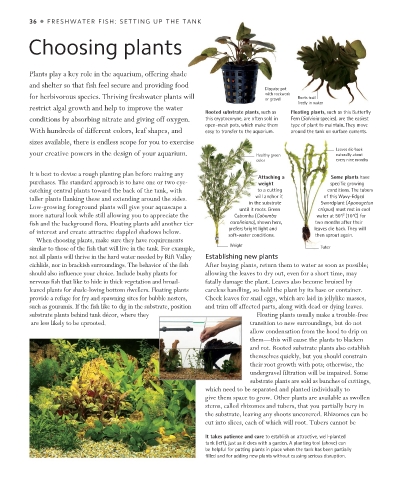
                                                          Rooted substrate plants, such as   Floating plants, such as this Butterfly
         conditions by absorbing nitrate and giving off oxygen.   this cryptocoryne, are often sold in   Fern (Salvinia species), are the easiest
                                                          open-mesh pots, which make them   type of plant to maintain. They move
         With hundreds of different colors, leaf shapes, and   easy to transfer to the aquarium.  around the tank on surface currents.
         sizes available, there is endless scope for you to exercise
         your creative powers in the design of your aquarium.           Healthy green         Leaves die back
                                                                                              naturally about
                                                                        color                 every nine months
         It is best to devise a rough planting plan before making any   Attaching a         Some plants have
         purchases. The standard approach is to have one or two eye-    weight              specific growing
         catching central plants toward the back of the tank, with      to a cutting       conditions. The tubers
         taller plants flanking these and extending around the sides.   will anchor it    of this Wavy-Edged
                                                                                         Swordplant (Aponogeton
                                                                      in the substrate
         Low-growing foreground plants will give your aquascape a   until it roots. Green   crispus) must rest in cool
         more natural look while still allowing you to appreciate the   Cabomba (Cabomba   water at 50°F (10°C) for
         fish and the background flora. Floating plants add another tier   caroliniana), shown here,   two months after their
         of interest and create attractive dappled shadows below.  prefers bright light and   leaves die back. They will
                                                                soft-water conditions.
                                                                                        then sprout again.
           When choosing plants, make sure they have requirements
         similar to those of the fish that will live in the tank. For example,   Weight  Tuber
         not all plants will thrive in the hard water needed by Rift Valley   Establishing new plants
         cichlids, nor in brackish surroundings. The behavior of the fish   After buying plants, return them to water as soon as possible;
         should also influence your choice. Include bushy plants for   allowing the leaves to dry out, even for a short time, may
         nervous fish that like to hide in thick vegetation and broad-  fatally damage the plant. Leaves also become bruised by
         leaved plants for shade-loving bottom dwellers. Floating plants   careless handling, so hold the plant by its base or container.
         provide a refuge for fry and spawning sites for bubble nesters,   Check leaves for snail eggs, which are laid in jellylike masses,
         such as gouramis. If the fish like to dig in the substrate, position   and trim off affected parts, along with dead or dying leaves.
         substrate plants behind tank décor, where they                 Floating plants usually make a trouble-free
          are less likely to be uprooted.                             transition to new surroundings, but do not
                                                                      allow condensation from the hood to drip on
                                                                      them—this will cause the plants to blacken
                                                                      and rot. Rooted substrate plants also establish
                                                                      themselves quickly, but you should constrain
                                                                      their root growth with pots; otherwise, the
                                                                      undergravel filtration will be impaired. Some
                                                                      substrate plants are sold as bunches of cuttings,
                                                          which need to be separated and planted individually to
                                                          give them space to grow. Other plants are available as swollen
                                                          stems, called rhizomes and tubers, that you partially bury in
                                                          the substrate, leaving any shoots uncovered. Rhizomes can be
                                                          cut into slices, each of which will root. Tubers cannot be
                                                          It takes patience and care to establish an attractive, well-planted
                                                          tank (left), just as it does with a garden. A planting tool (above) can
                                                          be helpful for putting plants in place when the tank has been partially
                                                          filled and for adding new plants without causing serious disruption.


   US_036-037_Choosing_Plants.indd   36                                                              29/08/18   4:08 PM

