


Page 36 - Encyclopedia of Aquarium and Pond Fish, 3rd Edition
P. 36
34    FRESHWATER FISH: SETTING UP THE TANK

         Filtration and aeration                                           FILTRATION TIPS


                                                                           •  Add zeolite sachets to remove ammonia
                  An effective aquarium filtration system not only removes waste   from the water and a starter seed culture of
                                                                           bacteria for the biological filter.
                   products from the water by physical or chemical means but also   •  Be careful not to overfeed the fish and
                    mirrors the process of biological filtration—the nitrogen   burden the filter with decomposing food.
                  cycle—that occurs in the wild. Filtration goes hand in hand with   •  Test the water quality regularly to check
                                                                           the filter’s efficiency; frequent partial
                  aeration, in which water is circulated so that it can absorb oxygen   water changes (see pp.50-52) will ease
                                                                           the pressure on the filtration system.
                        from the air and lose unwanted carbon dioxide.

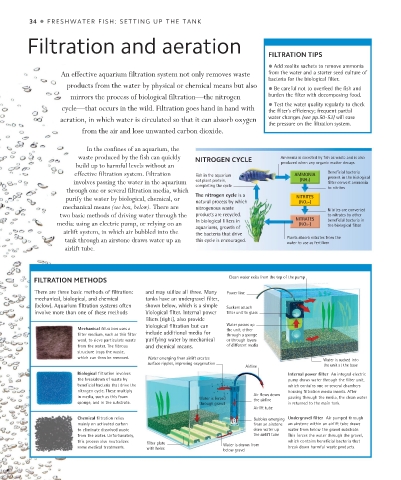
                         In the confines of an aquarium, the
                       waste produced by the fish can quickly   NITROGEN CYCLE  Ammonia is excreted by fish as waste and is also
                      build up to harmful levels without an                   produced when any organic matter decays
                      effective filtration system. Filtration   Fish in the aquarium   AMMONIA  Beneficial bacteria
                     involves passing the water in the aquarium   eat plant protein,   (NH3)  present in the biological
                                                                                           filter convert ammonia
                                                       completing the cycle
                   through one or several filtration media, which                          to nitrites
                   purify the water by biological, chemical, or   The nitrogen cycle is a   NITRITES
                                                       natural process by which
                                                                                   (NO2-)
                  mechanical means (see box, below). There are   nitrogenous waste         Nitrites are converted
                  two basic methods of driving water through the   products are recycled.    to nitrates by other
                 media: using an electric pump, or relying on an   In biological filters in   NITRATES  beneficial bacteria in
                                                                                   (NO3-)
                                                                                           the biological filter
                   airlift system, in which air bubbled into the   aquariums, growth of
                                                       the bacteria that drive
                   tank through an airstone draws water up an   this cycle is encouraged.  Plants absorb nitrates from the
                                                                                water to use as fertilizer
                   airlift tube.
          FILTRATION METHODS                                    Clean water exits from the top of the pump
           There are three basic methods of filtration:   and may utilize all three. Many   Power line
           mechanical, biological, and chemical   tanks have an undergravel filter,
           (below). Aquarium filtration systems often   shown below, which is a simple   Suckers attach
           involve more than one of these methods   biological filter. Internal power   filter unit to glass
                                         filters (right), also provide
                                         biological filtration but can   Water passes up
                      Mechanical filtration uses a             the unit, either
                      filter medium, such as this filter   include additional media for   through a sponge
                      wool, to sieve particulate waste   purifying water by mechanical   or through layers
                      from the water. The fibrous   and chemical means.  of different media
                      structure traps the waste,
                      which can then be removed.  Water emerging from airlift creates     Water is sucked into
                                          surface ripples, improving oxygenation          the unit at the base
                                                                     Airline
                      Biological filtration involves                            Internal power filter  An integral electric
                      the breakdown of waste by                                 pump draws water through the filter unit,
                      beneficial bacteria that drive the                        which contains one or several chambers
                      nitrogen cycle. These multiply                            housing filtration media inserts. After
                      in media, such as this foam       Water is forced   Air flows down   passing through the media, the clean water
                                                                       the airline
                      sponge, and in the substrate.     through gravel          is returned to the main tank.
                                                                       Airlift tube
                      Chemical filtration relies                       Bubbles emerging  Undergravel filter  Air pumped through
                      mainly on activated carbon                       from an airstone   an airstone within an airlift tube draws
                      to eliminate dissolved waste                     draw water up   water from below the gravel substrate.
                      from the water. Unfortunately,                   the airlift tube  This forces the water through the gravel,
                      this process also neutralizes    Filter plate             which contains beneficial bacteria that
                      some medical treatments.  with holes     Water is drawn from   break down harmful waste products.
                                                               below gravel


   US_034-035_Filtration_Aeration.indd   34                                                          29/08/18   4:08 PM

