


Page 344 - Encyclopedia of Aquarium and Pond Fish, 3rd Edition
P. 344
342    POND FISH DIRECTORY


          Carassius auratus
         Celestial
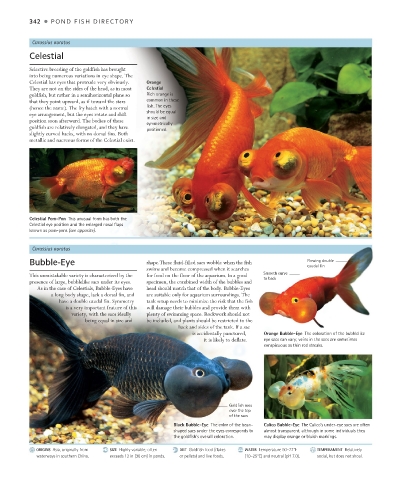
         Selective breeding of the goldfish has brought
         into being numerous variations in eye shape. The
         Celestial has eyes that protrude very obviously.   Orange
         They are not on the sides of the head, as in most   Celestial
         goldfish, but rather in a semihorizontal plane so   Rich orange is
         that they point upward, as if toward the stars   common in these
         (hence the name). The fry hatch with a normal    fish. The eyes
         eye arrangement, but the eyes rotate and shift   should be equal
                                         in size and
         position soon afterward. The bodies of these   symmetrically
         goldfish are relatively elongated, and they have   positioned.
         slightly curved backs, with no dorsal fins. Both
         metallic and nacreous forms of the Celestial exist.


         Celestial Pom-Pon  This unusual form has both the
         Celestial eye position and the enlarged nasal flaps
         known as pom-pons (see opposite).

          Carassius auratus
         Bubble-Eye                      shape.These fluid-filled sacs wobble when the fish   Flowing double
                                         swims and become compressed when it searches   caudal fin
         This unmistakable variety is characterized by the   for food on the floor of the aquarium. In a good   Smooth curve
                                                                          to back
         presence of large, bubblelike sacs under its eyes.    specimen, the combined width of the bubbles and
           As in the case of Celestials, Bubble-Eyes have    head should match that of the body. Bubble-Eyes
               a long body shape, lack a dorsal fin, and   are suitable only for aquarium surroundings. The
                 have a double caudal fin. Symmetry   tank setup needs to minimize the risk that the fish
                   is a very important feature of this   will damage their bubbles and provide them with
                     variety, with the sacs ideally   plenty of swimming space. Rockwork should not
                         being equal in size and   be included, and plants should be restricted to the
                                                  back and sides of the tank. If a sac
                                                      is accidentally punctured,    Orange Bubble-Eye  The coloration of the bubblelike
                                                         it is likely to deflate.  eye sacs can vary; veins in the sacs are sometimes
                                                                          conspicuous as thin red streaks.


                                                                Goldfish sees
                                                                over the top
                                                                of the sacs
                                                 Black Bubble-Eye  The color of the bean-   Calico Bubble-Eye  The Calico’s under-eye sacs are often
                                                 shaped sacs under the eyes corresponds to   almost transparent, although in some individuals they
                                                 the goldfish’s overall coloration.  may display orange or bluish markings.
           ORIGINS  Asia, originally from   SIZE  Highly variable; often   DIET  Goldfish food (flakes    WATER  Temperature 50–77°F   TEMPERAMENT  Relatively
           waterways in southern China.  exceeds 12 in (30 cm) in ponds.  or pellets) and live foods.  (10–25°C) and neutral (pH 7.0).  social, but does not shoal.


   US_342-343_Goldfish_6.indd   342                                                                  29/08/18   4:11 PM

