


Page 343 - Encyclopedia of Aquarium and Pond Fish, 3rd Edition
P. 343
GOLDFISH     341


           BREEDING GOLDFISH IN PONDS AND AQUARIUMS


           Goldfish can be spawned
           successfully in both aquariums and
           ponds. Outdoors, spawning typically
           occurs in the mornings on warm days.
           The males chase after the females and
           nudge at their flanks to encourage them to
           release their eggs. It is advisable to cover the
           pond with a net when the fish are likely to
           spawn, because they often break the surface at
           this time. The resulting disturbance can attract
           predators, such as cats, herons, and seagulls.
             A special breeding tank is recommended for
           aquarium fish, which are otherwise likely to eat
           all their spawn. In a well-planted pond, however,
           with a good undergrowth of oxygenators, some
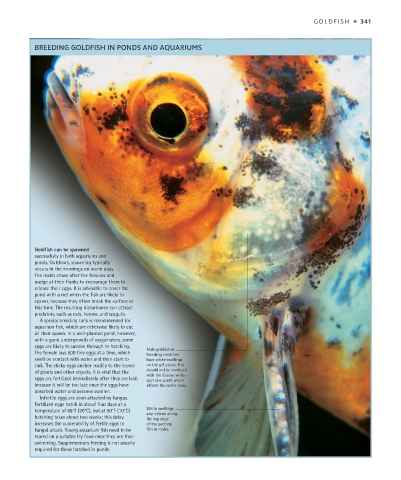
           eggs are likely to survive through to hatching.   Male goldfish in
           The female lays 500 tiny eggs at a time, which   breeding condition
           swell on contact with water and then start to   have white swellings
           sink. The sticky eggs anchor readily to the leaves   on the gill plates. This
           of plants and other objects. It is vital that the   should not be confused
                                         with the disease white-
           eggs are fertilized immediately after they are laid,   spot (see p.58), which
           because it will be too late once the eggs have   affects the entire body.
           absorbed water and become swollen.
             Infertile eggs are soon attacked by fungus.
           Fertilized eggs hatch in about four days at a
           temperature of 68°F (20°C), but at 50°F (10°C)   White swellings
                                         also extend along
           hatching takes about two weeks; this delay   the top edge
           increases the vulnerability of fertile eggs to   of the pectoral
           fungal attack. Young aquarium fish need to be   fins in males.
           reared on a suitable fry food once they are free-
           swimming. Supplementary feeding is not usually
           required for those hatched in ponds.


   US_340-341_Goldfish_5.indd   341                                                                  29/08/18   4:11 PM

