


Page 367 - Encyclopedia of Aquarium and Pond Fish, 3rd Edition
P. 367
MARGINAL PLANTS     365


          Carex elata ‘Aurea’             Eriophorum angustifolium
         Bowles’ Golden Sedge            Cotton Grass

           ORIGINS  The native form is widely distributed   ORIGINS  Widely distributed in temperate regions of the
           throughout temperate regions of the world.  northern hemisphere.
           SIZE  Reaches about 24 in (60 cm) in height.  SIZE  Grows to a height of about 12 in (30 cm).
           WATER  Can be grown in shallow water, or alternatively   WATER  Set on the marginal shelf 2 in (5 cm) below the
           in damp earth. Hardy to –20°F (–29°C).  waterline, or in damp soil. Hardy to –30°F (–34°C).
           PROPAGATION  This can easily be accomplished by the   PROPAGATION  Usually by the division of the rootstock,
           division of existing plants in the spring.  although it can also be grown from seed.
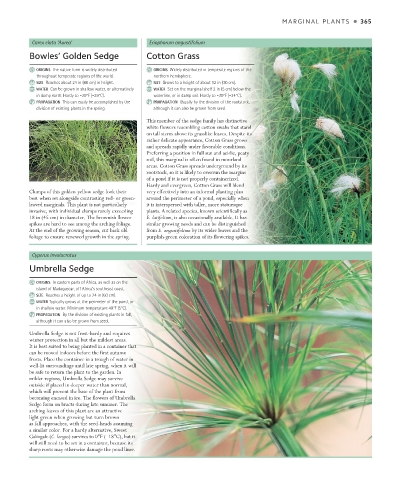
                                         This member of the sedge family has distinctive
                                         white flowers resembling cotton swabs that stand
                                         on tall stems above its grasslike leaves. Despite its
                                         rather delicate appearance, Cotton Grass grows
                                         and spreads rapidly under favorable conditions.
                                         Preferring a position in full sun and acidic, peaty
                                         soil, this marginal is often found in moorland
                                         areas. Cotton Grass spreads underground by its
                                         rootstock, so it is likely to overrun the margins
                                         of a pond if it is not properly containerized.
                                         Hardy and evergreen, Cotton Grass will blend
         Clumps of this golden-yellow sedge look their    very effectively into an informal planting plan
         best when set alongside contrasting red- or green-    around the perimeter of a pond, especially when
         leaved marginals. This plant is not particularly   it is interspersed with taller, more statuesque
         invasive, with individual clumps rarely exceeding   plants. A related species, known scientifically as
         18 in (45 cm) in diameter. The brownish flower   E. latifolium, is also occasionally available. It has
         spikes are hard to see among the arching foliage.   similar growing needs and can be distinguished
         At the end of the growing season, cut back old   from E. angustifolium by its wider leaves and the
         foliage to ensure renewed growth in the spring.  purplish-green coloration of its flowering spikes.

          Cyperus involucratus
         Umbrella Sedge

           ORIGINS  In eastern parts of Africa, as well as on the
           island of Madagascar, off Africa’s southeast coast.
           SIZE  Reaches a height of up to 24 in (60 cm).
           WATER Typically grows at the perimeter of the pond, or
           in shallow water. Minimum temperature 40°F (5°C).
           PROPAGATION  By the division of existing plants in fall,
           although it can also be grown from seed.
         Umbrella Sedge is not frost-hardy and requires
         winter protection in all but the mildest areas.
         It is best suited to being planted in a container that
         can be moved indoors before the first autumn
         frosts. Place the container in a trough of water in
         well-lit surroundings until late spring, when it will
         be safe to return the plant to the garden. In
         milder regions, Umbrella Sedge may survive
         outside if placed in deeper water than normal,
         which will prevent the base of the plant from
         becoming encased in ice. The flowers of Umbrella
         Sedge form on bracts during late summer. The
         arching leaves of this plant are an attractive
         light green when growing but turn brown
         as fall approaches, with the seed-heads assuming
         a similar color. For a hardy alternative, Sweet
         Galingale (C. longus) survives to 0°F (–18°C), but it
         will still need to be set in a container, because its
         sharp roots may otherwise damage the pond liner.


   US_364-365_Marginals_1.indd   365                                                                 29/08/18   4:11 PM

