


Page 368 - Encyclopedia of Aquarium and Pond Fish, 3rd Edition
P. 368
366    POND PLANT DIRECTORY


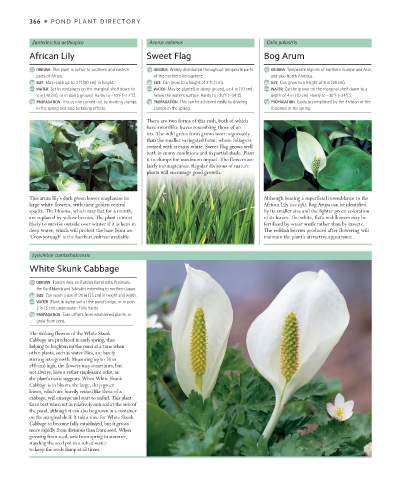
          Zantedeschia aethiopica         Acorus calamus                  Calla palustris
         African Lily                    Sweet Flag                       Bog Arum

           ORIGINS  This plant is native to southern and eastern   ORIGINS  Widely distributed throughout temperate parts   ORIGINS  Temperate regions of northern Europe and Asia,
           parts of Africa.                of the northern hemisphere.      and also North America.
           SIZE  May reach up to 3 ft (90 cm) in height.  SIZE  Can grow to a height of 3 ft (1 m).  SIZE  Can grow to a height of 8 in (20 cm).
           WATER  Set in containers on the marginal shelf down to   WATER  May be planted in damp ground, or 4 in (10 cm)   WATER  Can be grown on the marginal shelf down to a
           8 in (20 cm), or in damp ground. Hardy to –10°F (–12°C).  below the water’s surface. Hardy to –30°F (–34°C).  depth of 4 in (10 cm). Hardy to –30°F (–34°C).
           PROPAGATION  This can be carried out by dividing clumps   PROPAGATION  This can be achieved easily by dividing   PROPAGATION  Easily accomplished by the division of the
           in the spring and also by taking offsets.  clumps in the spring.  rhizomes in the spring.
                                         There are two forms of this rush, both of which
                                         have swordlike leaves resembling those of an
                                         iris. The wild green form grows more vigorously
                                         than the smaller variegated form, whose foliage is
                                         striped with creamy white. Sweet Flag grows well
                                         both in sunny conditions and in partial shade. Plant
                                         it in clumps for maximum impact. The flowers are
                                         fairly inconspicuous. Regular divisions of mature
                                         plants will encourage good growth.


         This arum lily’s dark green leaves emphasize its                 Although bearing a superficial resemblance to the
         large white flowers, with their golden central                   African Lily (see left), Bog Arum can be identified
         spadix. The blooms, which may last for a month,                  by its smaller size and the lighter green coloration
         are replaced by yellow berries. The plant is most                of its leaves. The white, flattened flowers may be
         likely to survive outside over winter if it is kept in           fertilized by water snails rather than by insects.
         deep water, which will protect the base from ice.                The reddish berries produced after flowering will
         ‘Crowborough’ is the hardiest cultivar available.                maintain the plant’s attractive appearance.

          Lysichiton camtschatcensis
         White Skunk Cabbage

           ORIGINS  Eastern Asia, on Russia’s Kamchatka Peninsula,
           the Kuril Islands and Sakhalin, extending to northern Japan.
           SIZE  Can reach a size of 30 in (75 cm) in height and width.
           WATER  Plant in damp soil at the pond’s edge, or in pots
           2 in (5 cm) underwater. Fully hardy.
           PROPAGATION  Take offsets from established plants, or
           grow from seed.
         The striking flowers of the White Skunk
         Cabbage are produced in early spring, thus
         helping to brighten up the pond at a time when
         other plants, such as water lilies, are barely
         stirring into growth. Measuring up to 16 in
         (40 cm) high, the flowers may sometimes, but
         not always, have a rather unpleasant odor, as
         the plant’s name suggests. When White Skunk
         Cabbage is in bloom, the large, deep green
         leaves, which are heavily veined like those of a
         cabbage, will emerge and start to unfurl. This plant
         fares best when set in relatively rich soil at the side of
         the pond, although it can also be grown in a container
         on the marginal shelf. It takes time for White Skunk
         Cabbage to become fully established, but it grows
         more rapidly from divisions than from seed. When
         growing from seed, sow from spring to summer,
         standing the seed pot in a tub of water
         to keep the seeds damp at all times.


   US_366-367_Marginals_2.indd   366                                                                 29/08/18   4:11 PM

