


Page 374 - Encyclopedia of Aquarium and Pond Fish, 3rd Edition
P. 374
372    POND PLANT DIRECTORY

         FLOATING PLANTS


         These plants are not renowned for their flowers,
         but they give the pond a more natural feel and are
         important for the well-being of the fish. They
         spread to form a dense mass, protecting the fish
         from predators, especially birds, and also from
         sunburn, in addition to curbing algal growth.
         Furthermore, they provide spawning sites and food
         for some species of fish. Floating plants are easy to
         establish—simply let them drift on the surface until
         they find a suitable position—and they develop much
         faster in a new pond than other types of plants,
         such as marginals and water lilies. Some popular   Water Chestnut
                                                     (Trapa natans) now
         varieties originate from warm climates and are    occurs far beyond its
                                                     native habitat and may
         not hardy in temperate areas. They should be    create environmental
                                                     problems in these
         brought inside to protect them from winter frosts.  new localities.

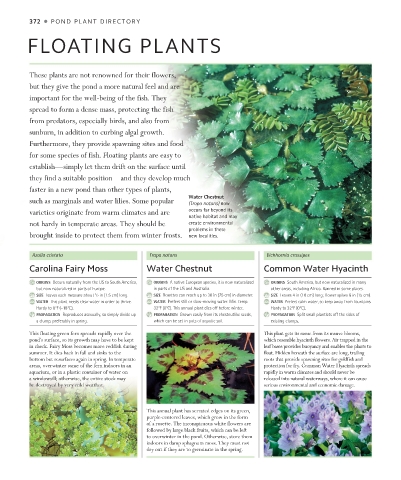
          Azolla cristata                 Trapa natans                    Eichhornia crassipes
         Carolina Fairy Moss             Water Chestnut                   Common Water Hyacinth

           ORIGINS  Occurs naturally from the US to South America,   ORIGINS  A native European species, it is now naturalized   ORIGINS  South America, but now naturalized in many
           but now naturalized in parts of Europe.  in parts of the US and Australia.  other areas, including Africa. Banned in some places.
           SIZE  Leaves each measure about  ⁄2 in (1.5 cm) long.  SIZE  Rosettes can reach up to 30 in (75 cm) in diameter.  SIZE  Leaves 4 in (10 cm) long; flower spikes 6 in (15 cm).
                           1
           WATER  This plant needs clear water in order to thrive.   WATER  Prefers still or slow-moving water. Min. temp.   WATER  Prefers calm water, so keep away from fountains.
           Hardy to 0°F (–18°C).           32°F (0°C). This annual plant dies off before winter.  Hardy to 32°F (0°C).
           PROPAGATION  Reproduces asexually, so simply divide up   PROPAGATION  Grown easily from its chestnutlike seeds,   PROPAGATION  Split small plantlets off the sides of
           a clump, preferably in spring.  which can be set in pots of aquatic soil.  existing clumps.
         This floating green fern spreads rapidly over the                This plant gets its name from its mauve blooms,
         pond’s surface, so its growth may have to be kept                which resemble hyacinth flowers. Air trapped in the
         in check. Fairy Moss becomes more reddish during                 leaf bases provides buoyancy and enables the plants to
         summer. It dies back in fall and sinks to the                    float. Hidden beneath the surface are long, trailing
         bottom but resurfaces again in spring. In temperate              roots that provide spawning sites for goldfish and
         areas, overwinter some of the fern indoors in an                 protection for fry. Common Water Hyacinth spreads
         aquarium, or in a plastic container of water on                  rapidly in warm climates and should never be
         a windowsill; otherwise, the entire stock may                    released into natural waterways, where it can cause
         be destroyed by very cold weather.                               serious environmental and economic damage.


                                         This annual plant has serrated edges on its green,
                                         purple-centered leaves, which grow in the form
                                         of a rosette. The inconspicuous white flowers are
                                         followed by large black fruits, which can be left
                                         to overwinter in the pond. Otherwise, store them
                                         indoors in damp sphagnum moss. They must not
                                         dry out if they are to germinate in the spring.


   US_372-373_Floating_Plants.indd   372                                                             29/08/18   4:11 PM

