


Page 52 - Encyclopedia of Aquarium and Pond Fish, 3rd Edition
P. 52
50    FRESHWATER FISH: MAINTENANCE

         Routine tasks


         A well-set-up tank that is functioning properly will require only
         a minimal amount of time spent on its maintenance. The
         aquarium should develop into a stable ecosystem, in which
         toxin levels are kept in check as part of the natural
         cycle. With regular checks and a few simple
         “housekeeping” tasks, such as partial water
         changes, your aquarium will look its best
         and your fish will stay healthy and content.

         Regular partial water changes ensure that toxic chemicals do
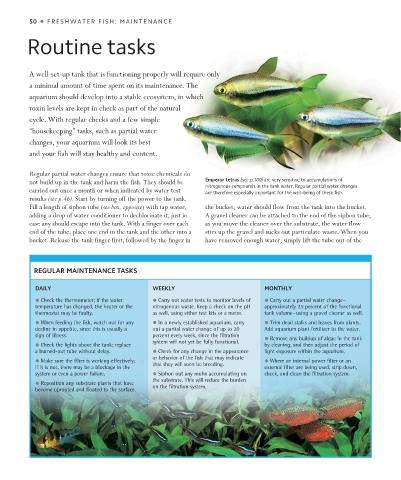
         not build up in the tank and harm the fish. They should be   Emperor tetras (see p.100) are very sensitive to accumulations of
         carried out once a month or when indicated by water test   nitrogenous compounds in the tank water. Regular partial water changes
                                                          are therefore especially important for the well-being of these fish.
         results (see p.46). Start by turning off the power to the tank.
         Fill a length of siphon tube (see box, opposite) with tap water,   the bucket; water should flow from the tank into the bucket.
         adding a drop of water conditioner to dechlorinate it, just in   A gravel cleaner can be attached to the end of the siphon tube;
         case any should escape into the tank. With a finger over each   as you move the cleaner over the substrate, the water flow
         end of the tube, place one end in the tank and the other into a   stirs up the gravel and sucks out particulate waste. When you
         bucket. Release the tank finger first, followed by the finger in   have removed enough water, simply lift the tube out of the


          REGULAR MAINTENANCE TASKS

           DAILY                           WEEKLY                         MONTHLY
           •  Check the thermometer; if the water   •  Carry out water tests to monitor levels of   •  Carry out a partial water change—
           temperature has changed, the heater or the   nitrogenous waste. Keep a check on the pH   approximately 25 percent of the functional
           thermostat may be faulty.       as well, using either test kits or a meter.  tank volume—using a gravel cleaner as well.
           •  When feeding the fish, watch out for any   •  In a newly established aquarium, carry   •  Trim dead stalks and leaves from plants.
           decline in appetite, since this is usually a   out a partial water change of up to 20   Add aquarium plant fertilizer to the water.
           sign of illness.                percent every week, since the filtration   •  Remove any buildup of algae in the tank
           •  Check the lights above the tank; replace    system will not yet be fully functional.   by cleaning, and then adjust the period of
           a burned-out tube without delay.  •  Check for any change in the appearance   light exposure within the aquarium.
           •  Make sure the filter is working effectively;   or behavior of the fish that may indicate   •  Where an internal power filter or an
                                           that they will soon be breeding.
           if it is not, there may be a blockage in the                   external filter are being used, strip down,
           system or even a power failure.   •  Siphon out any mulm accumulating on   check, and clean the filtration system.
           •  Reposition any substrate plants that have   the substrate. This will reduce the burden
           become uprooted and floated to the surface.  on the filtration system.


   US_050-051_Routine_Maint_Health_2.indd   50                                                       29/08/18   4:08 PM

