


Page 54 - Encyclopedia of Aquarium and Pond Fish, 3rd Edition
P. 54
52    FRESHWATER FISH: MAINTENANCE

         tank decor. Reducing the length of time that the aquarium   nitrite poisoning when this chemical is present in concentrations
         lights are on will help to curb this problem, as will making   of just 0.5 mg/liter, whereas most other fish will be unaffected
         regular partial water changes (which keep the nitrate levels   until the level rises to 10–20 mg/liter. Ammonia can be
         low) and introducing fish that browse on algae.  removed by the chemical zeolite, which is either added to the
                                                          filter (if present) or simply dropped into the water.
         Monitoring water quality
         Test kits and meters (see p.46) should be used to make weekly
         checks on the water quality. Daily visual checks are also vital;
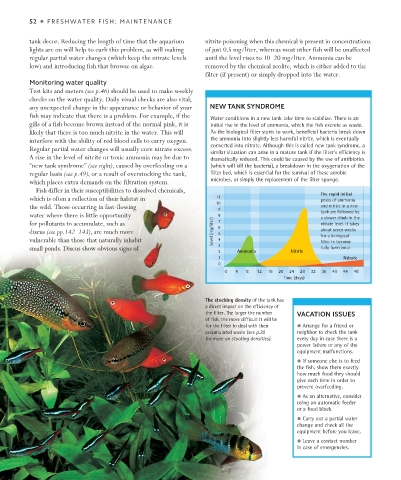
         any unexpected change in the appearance or behavior of your   NEW TANK SYNDROME
         fish may indicate that there is a problem. For example, if the   Water conditions in a new tank take time to stabilize. There is an
         gills of a fish become brown instead of the normal pink, it is   initial rise in the level of ammonia, which the fish excrete as waste.
         likely that there is too much nitrite in the water. This will   As the biological filter starts to work, beneficial bacteria break down
         interfere with the ability of red blood cells to carry oxygen.   the ammonia into slightly less harmful nitrite, which is eventually
         Regular partial water changes will usually cure nitrate excess.    converted into nitrate. Although this is called new tank syndrome, a
                                                           similar situation can arise in a mature tank if the filter’s efficiency is
         A rise in the level of nitrite or toxic ammonia may be due to   dramatically reduced. This could be caused by the use of antibiotics
         “new tank syndrome” (see right), caused by overfeeding on a   (which will kill the bacteria), a breakdown in the oxygenation of the
         regular basis (see p.49), or a result of overstocking the tank,   filter bed, which is essential for the survival of these aerobic
         which places extra demands on the filtration system.   microbes, or simply the replacement of the filter sponge.
           Fish differ in their susceptibilities to dissolved chemicals,
         which is often a reflection of their habitat in     11                          The rapid initial
                                                                                         peaks of ammonia
         the wild. Those occurring in fast-flowing           10 9                        and nitrite in a new
         water where there is little opportunity             8                           tank are followed by
                                                                                         a slower climb in the
         for pollutants to accumulate, such as               7                           nitrate level. It takes
         discus (see pp.142–143), are much more             Level (mg/liter)  6 5        about seven weeks
                                                                                         for a biological
         vulnerable than those that naturally inhabit        4                           filter to become
         small ponds. Discus show obvious signs of           3                           fully functional.
                                                             2    Ammonia        Nitrite
                                                             1                                  Nitrate
                                                             0
                                                               0  4  8  12  16  20  24  28  32  36  40  44  48
                                                                               Time (days)

                                                          The stocking density of the tank has
                                                          a direct impact on the efficiency of
                                                          the filter. The larger the number    VACATION ISSUES
                                                          of fish, the more difficult it will be
                                                          for the filter to deal with their   •  Arrange for a friend or
                                                          accumulated waste (see p.30    neighbor to check the tank
                                                          for more on stocking densities).  every day in case there is a
                                                                                   power failure or any of the
                                                                                   equipment malfunctions.
                                                                                   •  If someone else is to feed
                                                                                   the fish, show them exactly
                                                                                   how much food they should
                                                                                   give each time in order to
                                                                                   prevent overfeeding.
                                                                                   •  As an alternative, consider
                                                                                   using an automatic feeder
                                                                                   or a food block.
                                                                                   •  Carry out a partial water
                                                                                   change and check all the
                                                                                   equipment before you leave.
                                                                                   •  Leave a contact number
                                                                                   in case of emergencies.


   US_052-053_Routine_Maint_Health_2.indd   52                                                       29/08/18   4:08 PM

