


Page 56 - Encyclopedia of Aquarium and Pond Fish, 3rd Edition
P. 56
54    FRESHWATER FISH:  ILLNESS AND TREATMENT

         Health concerns

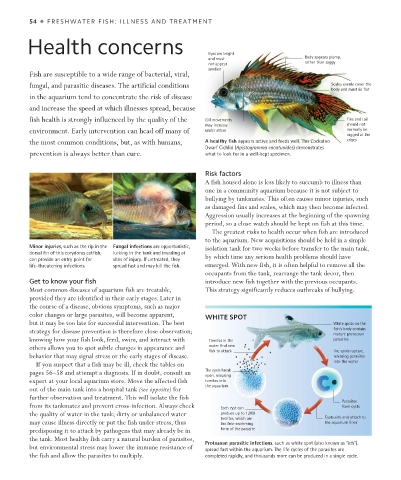
                                                          Eyes are bright
                                                          and must                   Body appears plump,
                                                          not appear                 rather than saggy
                                                          swollen
         Fish are susceptible to a wide range of bacterial, viral,
         fungal, and parasitic diseases. The artificial conditions                          Scales evenly cover the
                                                                                            body and must lie flat
         in the aquarium tend to concentrate the risk of disease
         and increase the speed at which illnesses spread, because
         fish health is strongly influenced by the quality of the   Gill movements               Fins and tail
                                                          may increase                           should not
         environment. Early intervention can head off many of   under stress                     normally be
                                                                                                 ragged at the
         the most common conditions, but, as with humans,   A healthy fish appears active and feeds well. This Cockatoo   edges
                                                          Dwarf Cichlid (Apistogramma cacatuoides) demonstrates
         prevention is always better than cure.           what to look for in a well-kept specimen.

                                                          Risk factors
                                                          A fish housed alone is less likely to succumb to illness than
                                                          one in a community aquarium because it is not subject to
                                                          bullying by tankmates. This often causes minor injuries, such
                                                          as damaged fins and scales, which may then become infected.
                                                          Aggression usually increases at the beginning of the spawning
                                                          period, so a close watch should be kept on fish at this time.
                                                           The greatest risks to health occur when fish are introduced
                                                          to the aquarium. New acquisitions should be held in a simple
         Minor injuries, such as the rip in the   Fungal infections are opportunistic,   isolation tank for two weeks before transfer to the main tank,
         dorsal fin of this corydoras catfish,   lurking in the tank and invading at   by which time any serious health problems should have
         can provide an entry point for   sites of injury. If untreated, they
         life-threatening infections.  spread fast and may kill the fish.   emerged. With new fish, it is often helpful to remove all the
                                                          occupants from the tank, rearrange the tank decor, then
         Get to know your fish                            introduce new fish together with the previous occupants.
         Most common diseases of aquarium fish are treatable,   This strategy significantly reduces outbreaks of bullying.
         provided they are identified in their early stages. Later in
         the course of a disease, obvious symptoms, such as major
         color changes or large parasites, will become apparent,    WHITE SPOT
         but it may be too late for successful intervention. The best                        White spots on the
         strategy for disease prevention is therefore close observation;                     fish’s body contain
                                                                                             mature protozoan
         knowing how your fish look, feed, swim, and interact with   Tomites in the          parasites
         others allows you to spot subtle changes in appearance and    water find new        The spots rupture,
                                                           fish to attack
         behavior that may signal stress or the early stages of disease.                     releasing parasites
           If you suspect that a fish may be ill, check the tables on                        into the water
         pages 56–58 and attempt a diagnosis. If in doubt, consult an   The cysts break
                                                          open, releasing
         expert at your local aquarium store. Move the affected fish   tomites into
         out of the main tank into a hospital tank (see opposite) for   the aquarium
         further observation and treatment. This will isolate the fish                         Parasites
         from its tankmates and prevent cross-infection. Always check   Each cyst can          form cysts
         the quality of water in the tank; dirty or unbalanced water   produce up to 1,000   Cysts sink and attach to
         may cause illness directly or put the fish under stress, thus   tomites, which are   the aquarium floor
                                                              the free-swimming
         predisposing it to attack by pathogens that may already be in   form of the parasite
         the tank. Most healthy fish carry a natural burden of parasites,
         but environmental stress may lower the immune resistance of   Protozoan parasitic infections, such as white spot (also known as “ich”),
                                                          spread fast within the aquarium. The life cycles of the parasites are
         the fish and allow the parasites to multiply.    completed rapidly, and thousands more can be produced in a single cycle.


   US_054-059_Illness_FW.indd   54                                                                   29/08/18   4:08 PM

