


Page 48 - Encyclopedia of Aquarium and Pond Fish, 3rd Edition
P. 48
46    FRESHWATER FISH: SETTING UP THE TANK

         Checking the water


         Maintaining water quality in the aquarium involves
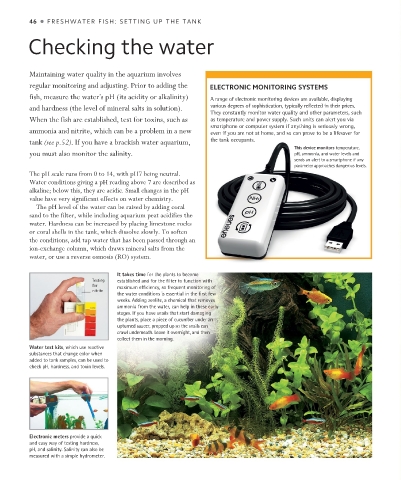
         regular monitoring and adjusting. Prior to adding the   ELECTRONIC MONITORING SYSTEMS
         fish, measure the water’s pH (its acidity or alkalinity)   A range of electronic monitoring devices are available, displaying
         and hardness (the level of mineral salts in solution).   various degrees of sophistication, typically reflected in their prices.
                                                           They constantly monitor water quality and other parameters, such
         When the fish are established, test for toxins, such as   as temperature and power supply. Such units can alert you via
                                                           smartphone or computer system if anything is seriously wrong,
         ammonia and nitrite, which can be a problem in a new   even if you are not at home, and so can prove to be a lifesaver for
         tank (see p.52). If you have a brackish water aquarium,   the tank occupants.
                                                                                  This device monitors temperature,
         you must also monitor the salinity.                                      pH, ammonia, and water levels and
                                                                                  sends an alert to a smartphone if any
                                                                                  parameter approaches dangerous levels.
         The pH scale runs from 0 to 14, with pH7 being neutral.
         Water conditions giving a pH reading above 7 are described as
         alkaline; below this, they are acidic. Small changes in the pH
         value have very significant effects on water chemistry.
           The pH level of the water can be raised by adding coral
         sand to the filter, while including aquarium peat acidifies the
         water. Hardness can be increased by placing limestone rocks
         or coral shells in the tank, which dissolve slowly. To soften
         the conditions, add tap water that has been passed through an
         ion-exchange column, which draws mineral salts from the
         water, or use a reverse osmosis (RO) system.


                                 It takes time for the plants to become
                          Testing   established and for the filter to function with
                          for    maximum efficiency, so frequent monitoring of
                          nitrite
                                 the water conditions is essential in the first few
                                 weeks. Adding zeolite, a chemical that removes
                                 ammonia from the water, can help in these early
                                 stages. If you have snails that start damaging
                                 the plants, place a piece of cucumber under an
                                 upturned saucer, propped up so the snails can
                                 crawl underneath. Leave it overnight, and then
                                 collect them in the morning.
         Water test kits, which use reactive
         substances that change color when
         added to tank samples, can be used to
         check pH, hardness, and toxin levels.


         Electronic meters provide a quick
         and easy way of testing hardness,
         pH, and salinity. Salinity can also be
         measured with a simple hydrometer.


   US_046-047_Checking_The_System.indd   46                                                          29/08/18   4:08 PM

