


Page 51 - Encyclopedia of Aquarium and Pond Fish, 3rd Edition
P. 51
FEEDING THE FISH     49

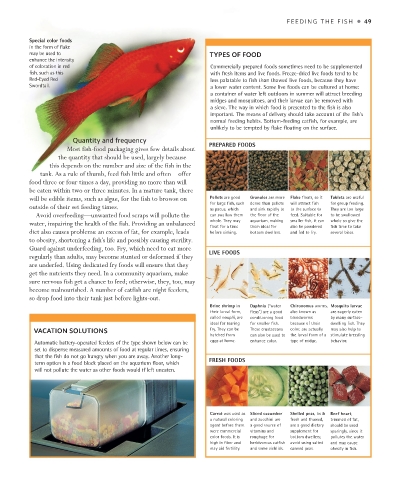
         Special color foods
         in the form of flake
         may be used to                                    TYPES OF FOOD
         enhance the intensity
         of coloration in red                              Commercially prepared foods sometimes need to be supplemented
         fish, such as this                                with fresh items and live foods. Freeze-dried live foods tend to be
         Red-Eyed Red                                      less palatable to fish than thawed live foods, because they have
         Swordtail.                                        a lower water content. Some live foods can be cultured at home:
                                                           a container of water left outdoors in summer will attract breeding
                                                           midges and mosquitoes, and their larvae can be removed with
                                                           a sieve. The way in which food is presented to the fish is also
                                                           important. The means of delivery should take account of the fish’s
                                                           normal feeding habits. Bottom-feeding catfish, for example, are
                                                           unlikely to be tempted by flake floating on the surface.
                     Quantity and frequency
                    Most fish-food packaging gives few details about   PREPARED FOODS
                 the quantity that should be used, largely because
               this depends on the number and size of the fish in the
            tank. As a rule of thumb, feed fish little and often—offer
         food three or four times a day, providing no more than will
         be eaten within two or three minutes. In a mature tank, there
         will be edible items, such as algae, for the fish to browse on   Pellets are good   Granules are more   Flake floats, so it   Tablets are useful
         outside of their set feeding times.               for large fish, such   dense than pellets   will attract fish   for group feeding.
                                                           as pacus, which
                                                                                            They are too large
                                                                                 to the surface to
                                                                      and sink rapidly to
           Avoid overfeeding—unwanted food scraps will pollute the   can swallow them   the floor of the   feed. Suitable for   to be swallowed
         water, impairing the health of the fish. Providing an unbalanced   whole. They may   aquarium, making   smaller fish, it can   whole so give the
                                                                                 also be powdered
                                                                      them ideal for
                                                                                            fish time to take
                                                           float for a time
         diet also causes problems: an excess of fat, for example, leads   before sinking.  bottom dwellers.  and fed to fry.  several bites.
         to obesity, shortening a fish’s life and possibly causing sterility.
         Guard against underfeeding, too. Fry, which need to eat more
         regularly than adults, may become stunted or deformed if they   LIVE FOODS
         are underfed. Using dedicated fry foods will ensure that they
         get the nutrients they need. In a community aquarium, make
         sure nervous fish get a chance to feed; otherwise, they, too, may
         become malnourished. A number of catfish are night feeders,
         so drop food into their tank just before lights-out.
                                                           Brine shrimp in   Daphnia (“water   Chironomus worms,   Mosquito larvae
                                                           their larval form,   fleas”) are a good   also known as   are eagerly eaten
                                                           called nauplii, are   conditioning food   bloodworms    by many surface-
                                                           ideal for rearing   for smaller fish.   because of their   dwelling fish. They
          VACATION SOLUTIONS                               fry. They can be   These crustaceans   color, are actually   may also help to
                                                           hatched from   can also be used to   the larval form of a   stimulate breeding
           Automatic battery-operated feeders of the type shown below can be   eggs at home.  enhance color.  type of midge.  behavior.
           set to dispense measured amounts of food at regular times, ensuring
           that the fish do not go hungry when you are away. Another long-   FRESH FOODS
           term option is a food block placed on the aquarium floor, which
           will not pollute the water as other foods would if left uneaten.


                                                           Carrot was used as   Sliced cucumber   Shelled peas, both   Beef heart,
                                                           a natural coloring   and zucchini are    fresh and thawed,   trimmed of fat,
                                                           agent before there   a good source of   are a good dietary   should be used
                                                           were commercial   vitamins and   supplement for   sparingly, since it
                                                           color foods. It is   roughage for   bottom dwellers;   pollutes the water
                                                           high in fiber and   herbivorous catfish   avoid using salted   and may cause
                                                           may aid fertility.  and some cichlids.  canned peas.  obesity in fish.


   US_048-049_Feeding_Fish.indd   49                                                                 29/08/18   4:08 PM

