


Page 156 - Atlas Of The World's Strangest Animals
P. 156
156      ATLAS  OF THE WORLD’S  STRANGEST ANIMALS


           Sloths are such famously slow-moving animals that their  they need to be extremely energy-efficient in their habits.
           name is a byword for laziness.Yet the truth is that these  This is why sloths move as little as possible and leave the
           lethargic creatures aren’t really lazy at all.They’re just  tree tops only once a week to defecate!
           superbly energy-efficient.                               They spend hours grazing in ultra-slow motion and,
             Sloths are folivores, which means that the bulk of their  after filling their bellies, sloths will settle down to sleep
           diet consists of leaves and buds.This isn’t an especially  for at least 10 hours each day.Their bodies are pared
           nutritious or energy-rich food source, so sloths have  down to an energy-efficient minimum. It takes a lot of
           enlarged stomachs with multiple compartments.These     food energy to build and maintain muscle, so sloths make
           compartments contain cellulose-digesting bacteria that  do with less than half the muscle mass of other mammals.
           help break down the tough fibres.Around two-thirds of  They are warm-blooded, but because they convert food
           the weight of a well-fed sloth consists of the contents of  into energy at half the rate of a similar-sized mammal
           their stomach, and their metabolisms are so slow they can  they have difficulty retaining a high or constant body
           take up to one month to completely digest a meal. Even  temperature. Instead, they warm themselves by snoozing
           then, they get so little fuel from the food they eat that  in selected sunny spots. If temperatures fall, then they


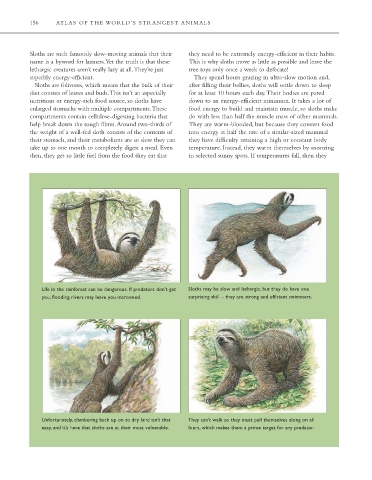
                Life in the rainforest can be dangerous. If predators don’t get  Sloths may be slow and lethargic, but they do have one
                you, flooding rivers may leave you marooned.      surprising skill –they are strong and efficient swimmers.


                Unfortunately, clambering back up on to dry land isn’t that  They can’t walk so they must pull themselves along on all
                easy, and it’s here that sloths are at their most vulnerable.  fours,which makes them a prime target for any predator.


                                             (c) 2011 Marshall Cavendish. All Rights Reserved.

