


Page 157 - Atlas Of The World's Strangest Animals
P. 157
THREE-TOED SLOTH              157


             curl into a ball, and rely on a special system of blood
                                                                     Three-toed sloth habitats
             vessels to focus warmth around their vital organs, where
             it’s most needed.


             Topsy-turvy
             Sloths can be found from Panama to northern Argentina,
             where they make their homes in the region’s tropical
             rainforests.While many animals are well adapted to an
             arboreal lifestyle, sloths are such specialists that their bodies
             have become truly extraordinary.
              Clambering about in the tree tops is tiring and so, to
             save energy, sloths eat, mate, give birth and nurse their
             young dangling, upside down, from a convenient branch.
             In fact, they have difficulty supporting their weight in an
             upright position, and must spend much of their time
             simply hanging around.They are able to do this thanks to
             a flexible spine, long limbs and a set of remarkably strong,
             curved claws.These claws make such efficient grappling
             hooks that dead sloths are difficult to dislodge from their
             branches! The result of such a topsy-turvy lifestyle has
             been that the position of many of the sloths’ internal
             organs is different from those of other mammals. Even  rainstorms to avoid drawing attention to themselves.
             their hair grows downwards, from their stomach towards  Their long, gray-brown hair blends in so well with the
             their back, so that rain water flows off when they’re   surrounding environment that when they curl into a ball
             upside down.                                           to sleep they can easily be mistaken for a termite nest or
              Despite their infamous lack of speed, life in the tree  a knot of vegetation. During the rainy season, this fur
             tops is surprisingly safe for a sloth, thanks to their natural  even takes on a coat of blue-green algae (species
             caution and camouflage.They rarely leave the safety of  Trichophilius and Cyanoderma), which provides additional
             the foliage and have even been known to urinate during  cryptic camouflage.


              Comparisons


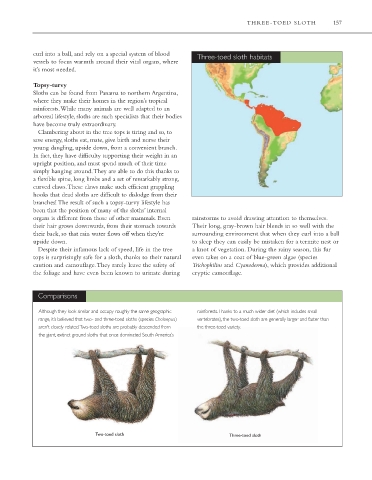
              Although they look similar and occupy roughly the same geographic  rainforests.Thanks to a much wider diet (which includes small
              range, it’s believed that two- and three-toed sloths (species Choloepus)  vertebrates), the two-toed sloth are generally larger and faster than
              aren’t closely related.Two-toed sloths are probably descended from  the three-toed variety.
              the giant, extinct ground sloths that once dominated South America’s


                                  Two-toed sloth                                Three-toed sloth


                                             (c) 2011 Marshall Cavendish. All Rights Reserved.

