


Page 163 - Atlas Of The World's Strangest Animals
P. 163
COMPASS JELLYFISH            163


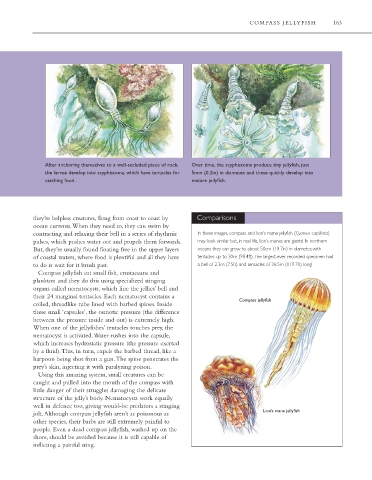
                 After anchoring themselves to a well-secluded piece of rock,  Over time, the scyphistoma produce tiny jellyfish,just
                 the larvae develop into scyphistoma,which have tentacles for  5mm (0.2in) in diameter, and these quickly develop into
                 catching food.                                    mature jellyfish.


             they’re helpless creatures, flung from coast to coast by  Comparisons
             ocean currents.When they need to, they can swim by
             contracting and relaxing their bell in a series of rhythmic  In these images, compass and lion’s mane jellyfish (Cyanea capillata)
             pulses, which pushes water out and propels them forwards.  may look similar but, in real life, lion’s manes are giants! In northern
             But, they’re usually found floating free in the upper layers  oceans they can grow to about 50cm (19.7in) in diameter, with
             of coastal waters, where food is plentiful and all they have  tentacles up to 30m (98.4ft).The largest-ever recorded specimen had
             to do is wait for it brush past.                        a bell of 2.3m (7.5ft) and tentacles of 36.5m (119.7ft) long!
              Compass jellyfish eat small fish, crustaceans and
             plankton and they do this using specialized stinging
             organs called nematocysts, which line the jellies’ bell and
             their 24 marginal tentacles. Each nematocyst contains a
                                                                                    Compass jellyfish
             coiled, threadlike tube lined with barbed spines. Inside
             these small ‘capsules’, the osmotic pressure (the difference
             between the pressure inside and out) is extremely high.
             When one of the jellyfishes’ tentacles touches prey, the
             nematocyst is activated.Water rushes into the capsule,
             which increases hydrostatic pressure (the pressure exerted
             by a fluid).This, in turn, expels the barbed thread, like a
             harpoon being shot from a gun.The spine penetrates the
             prey’s skin, injecting it with paralyzing poison.
              Using this amazing system, small creatures can be
             caught and pulled into the mouth of the compass with
             little danger of their struggles damaging the delicate
             structure of the jelly’s body. Nematocysts work equally
             well in defence too, giving would-be predators a stinging
                                                                                            Lion’s mane jellyfish
             jolt.Although compass jellyfish aren’t as poisonous as
             other species, their barbs are still extremely painful to
             people. Even a dead compass jellyfish, washed up on the
             shore, should be avoided because it is still capable of
             inflicting a painful sting.


                                             (c) 2011 Marshall Cavendish. All Rights Reserved.

