


Page 162 - Atlas Of The World's Strangest Animals
P. 162
162      ATLAS  OF THE WORLD’S  STRANGEST ANIMALS


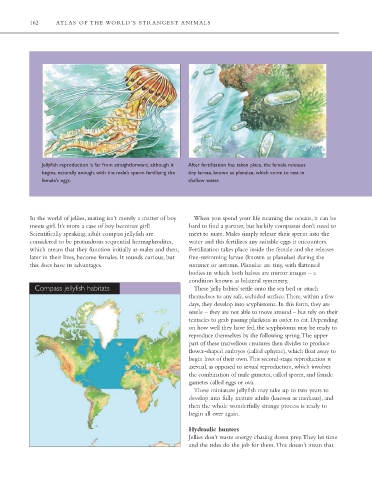
                Jellyfish reproduction is far from straightforward, although it  After fertilization has taken place, the female releases
                begins, naturally enough,with the male’s sperm fertilizing the  tiny larvae, known as planulae,which come to rest in
                female’s eggs.                                    shallow water.


           In the world of jellies, mating isn’t merely a matter of boy  When you spend your life roaming the oceans, it can be
           meets girl. It’s more a case of boy becomes girl!      hard to find a partner, but luckily compasses don’t need to
           Scientifically speaking, adult compass jellyfish are   meet to mate. Males simply release their sperm into the
           considered to be protandrous sequential hermaphrodites,  water and this fertilizes any suitable eggs it encounters.
           which means that they function initially as males and then,  Fertilization takes place inside the female and she releases
           later in their lives, become females. It sounds curious, but  free-swimming larvae (known as planulae) during the
           this does have its advantages.                         summer or autumn. Planulae are tiny, with flattened
                                                                  bodies in which both halves are mirror images – a
                                                                  condition known as bilateral symmetry.
             Compass jellyfish habitats                             These ‘jelly babies’ settle onto the sea bed or attach
                                                                  themselves to any safe, secluded surface.There, within a few
                                                                  days, they develop into scyphistoma. In this form, they are
                                                                  sessile – they are not able to move around – but rely on their
                                                                  tentacles to grab passing plankton in order to eat. Depending
                                                                  on how well they have fed, the scyphistoma may be ready to
                                                                  reproduce themselves by the following spring.The upper
                                                                  part of these marvellous creatures then divides to produce
                                                                  flower-shaped embryos (called ephyrae), which float away to
                                                                  begin lives of their own.This second-stage reproduction is
                                                                  asexual, as opposed to sexual reproduction, which involves
                                                                  the combination of male gametes, called sperm, and female
                                                                  gametes called eggs or ova.
                                                                    These miniature jellyfish may take up to two years to
                                                                  develop into fully mature adults (known as medusas), and
                                                                  then the whole wonderfully strange process is ready to
                                                                  begin all over again.

                                                                  Hydraulic hunters
                                                                  Jellies don’t waste energy chasing down prey.They let time
                                                                  and the tides do the job for them.This doesn’t mean that


                                             (c) 2011 Marshall Cavendish. All Rights Reserved.

