


Page 208 - Atlas Of The World's Strangest Animals
P. 208
208      ATLAS  OF THE WORLD’S  STRANGEST ANIMALS


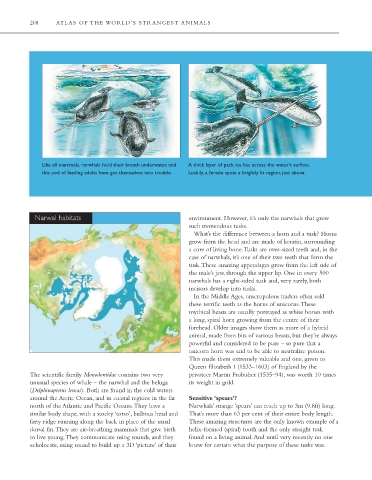
                Like all mammals, narwhals hold their breath underwater, and  A thick layer of pack ice lies across the water’s surface.
                this pod of feeding adults have got themselves into trouble.  Luckily, a female spots a brightly lit region,just above.


             Narwal habitats                                      environment. However, it’s only the narwhals that grow
                                                                  such tremendous tusks.
                                                                    What’s the difference between a horn and a tusk? Horns
                                                                  grow from the head and are made of keratin, surrounding
                                                                  a core of living bone.Tusks are over-sized teeth and, in the
                                                                  case of narwhals, it’s one of their two teeth that form the
                                                                  tusk.These amazing appendages grow from the left side of
                                                                  the male’s jaw, through the upper lip. One in every 500
                                                                  narwhals has a right-sided tusk and, very rarely, both
                                                                  incisors develop into tusks.
                                                                    In the Middle Ages, unscrupulous traders often sold
                                                                  these terrific teeth as the horns of unicorns.These
                                                                  mythical beasts are usually portrayed as white horses with
                                                                  a long, spiral horn growing from the centre of their
                                                                  forehead. Older images show them as more of a hybrid
                                                                  animal, made from bits of various beasts, but they’re always
                                                                  powerful and considered to be pure – so pure that a
                                                                  unicorn horn was said to be able to neutralize poison.
                                                                  This made them extremely valuable and one, given to
                                                                  Queen Elizabeth I (1533–1603) of England by the
           The scientific family Monodontidae contains two very   privateer Martin Frobisher (1535–94), was worth 10 times
           unusual species of whale – the narwhal and the beluga  its weight in gold.
           (Delphinapterus leucas). Both are found in the cold waters
           around the Arctic Ocean, and in coastal regions in the far  Sensitive ‘spears’?
           north of the Atlantic and Pacific Oceans.They have a   Narwhals’ strange ‘spears’ can reach up to 3m (9.8ft) long.
           similar body shape, with a stocky ‘torso’, bulbous head and  That’s more than 63 per cent of their entire body length.
           fatty ridge running along the back in place of the usual  These amazing structures are the only known example of a
           dorsal fin.They are air-breathing mammals that give birth  helix-formed (spiral) tooth and the only straight tusk
           to live young.They communicate using sounds, and they  found on a living animal.And until very recently no one
           echolocate, using sound to build up a 3D ‘picture’ of their  knew for certain what the purpose of these tusks was.


                                             (c) 2011 Marshall Cavendish. All Rights Reserved.

