


Page 209 - Atlas Of The World's Strangest Animals
P. 209
NARWAL         209


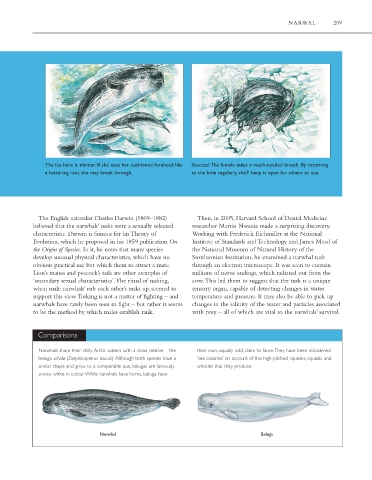
                 The ice here is thinner. If she uses her cushioned forehead like  Success! The female takes a much-needed breath. By returning
                 a battering ram, she may break through.           to the hole regularly, she’ll keep it open for others to use.


              The English naturalist Charles Darwin (1809–1882)      Then, in 2005, Harvard School of Dental Medicine
             believed that the narwhals’ tusks were a sexually selected  researcher Martin Nweeia made a surprising discovery.
             characteristic. Darwin is famous for his Theory of     Working with Frederick Eichmiller at the National
             Evolution, which he proposed in his 1859 publication On  Institute of Standards and Technology and James Mead of
             the Origin of Species. In it, he notes that many species  the National Museum of Natural History of the
             develop unusual physical characteristics, which have no  Smithsonian Institution, he examined a narwhal tusk
             obvious practical use but which them to attract a mate.  through an electron microscope. It was seen to contain
             Lion’s manes and peacock’s tails are other examples of  millions of nerve endings, which radiated out from the
             ‘secondary sexual characteristics’.The ritual of tusking,  core.This led them to suggest that the tusk is a unique
             when male narwhals’ rub each other’s tusks up, seemed to  sensory organ, capable of detecting changes in water
             support this view.Tusking is not a matter of fighting – and  temperature and pressure. It may also be able to pick up
             narwhals have rarely been seen to fight – but rather it seems  changes in the salinity of the water and particles associated
             to be the method by which males establish rank.        with prey – all of which are vital to the narwhals’ survival.


              Comparisons

              Narwhals share their chilly Arctic waters with a close relative –the  their own, equally odd, claim to fame.They have been nicknamed
              beluga whale (Delphinapterus leucas). Although both species have a  ‘sea canaries’ on account of the high-pitched squeaks, squeals and
              similar shape and grow to a comparable size, belugas are famously  whistles that they produce
              snowy white in colour.While narwhals have horns, beluga have


                                    Narwhal                                                Beluga


                                             (c) 2011 Marshall Cavendish. All Rights Reserved.

