


Page 288 - The Book of Caterpillars: A Life-Size Guide to Six Hundred Species From Around the World
P. 288
MOTH CATERPILLARS

                                                     FAMILY  Psychidae
                                                 DISTRIBUTION  Eastern United States, west to New Mexico, and south to
                                                          the Caribbean
                                                    HABITAT  Forests and also urban trees
                                                  HOST PLANTS  At least 50 families of deciduous and evergreen trees and shrubs,
                                                          including juniper and cedar (Juniperus spp.), oak (Quercus spp.),
                                                          willow (Salix spp.), maple (Acer spp.), and pine (Pinus spp.)
                                                      NOTE  Caterpillar that lives inside a silk bag decorated with vegetation
                                             CONSERVATION STATUS  Not evaluated, but common


            ADULT WINGSPAN
           ¾–1 ⁄   in (20–30 mm)
           CATERPILLAR LENGTH

⁄  –1¼ in (24–32 mm)
                                                               THYRIDOPTERYX EPHEMERAEFORMIS
                                                      EVERGREEN BAGWORM
    286
                                                                                   (HAWORTH, 1803)


                                            Evergreen Bagworm caterpillars hatch from eggs laid by
                                            the wingless adult female in the bag that she, as a caterpillar,
                                            constructed. The young larvae are dispersed through the air,

                                            attached to silk threads—the only e ective method of dispersal
                                            over greater distances. Once they land and start feeding on the
                      Actual size
                                            new host, the caterpillars construct their own silk bags around
                                            themselves, continuing to enlarge them and attaching fragments
                                            of foliage throughout their growth. Excrement is expelled from

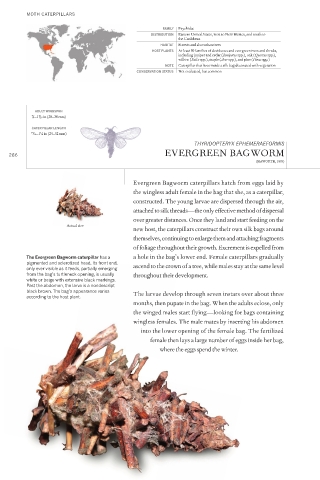
         The Evergreen Bagworm caterpillar has a   a hole in the bag’s lower end. Female caterpillars gradually
         pigmented and sclerotized head. Its front end,   ascend to the crown of a tree, while males stay at the same level
         only ever visible as it feeds, partially emerging
         from the bag’s turtleneck opening, is usually   throughout their development.
         white or beige with extensive black markings.
         Past the abdomen, the larva is a nondescript
         black brown. The bag’s appearance varies   The larvae develop through seven instars over about three
         according to the host plant.
                                            months, then pupate in the bag. When the adults eclose, only
                                            the winged males start flying—looking for bags containing
                                            wingless females. The male mates by inserting his abdomen
                                              into the lower opening of the female bag. The fertilized
                                                 female then lays a large number of eggs inside her bag,
                                                    where the eggs spend the winter.

