


Page 283 - The Book of Caterpillars: A Life-Size Guide to Six Hundred Species From Around the World
P. 283
BUTTERFLY CATERPILLARS

                      FAMILY  Nymphalidae
                  DISTRIBUTION  Every continent, except Antarctica
                     HABITAT  Most habitats from urban to mountaintops
                  HOST PLANTS  Wide variety, including thistle (Cirsium spp.), nettle (Urtica spp.),
                           mallows (Malvaceae), and legumes (Fabaceae)
                      NOTE  Well-known species often reared to teach students
                           about metamorphosis
             CONSERVATION STATUS  Not evaluated, but widespread and common


                                                                                   ADULT WINGSPAN
                                                                                  2¾–3 in (70–75 mm)
                                                                                  CATERPILLAR LENGTH
                                                                                    1¼ in (32 mm)
            VANESSA CARDUI
            PAINTED LADY                                                                         281

            (LINNAEUS, 1758)


            Painted Lady caterpillars hatch from green, inconspicuous
            eggs laid singly on host plants. Their development is rapid,
            taking three weeks from egg hatch to pupation. Adults eclose
            ten days later. The caterpillars feed on leaves primarily, and
            all instars build protective nests made out of a web of silk;
            in later instars these incorporate leaves that are curled or silked
            together. First instars feed and rest on upper leaf surfaces,
            covering themselves with a few strands of silk. Nests become
            more complex as the caterpillars mature, but there is only one   Actual size
            caterpillar per nest. A considerable amount of frass collects at
            the bottom of the nest.


            As the caterpillars wander before pupating, the pupae are usually
            formed in sheltered areas away from the host plant. Immature
            stages do not diapause, but adults migrate toward lower latitude
            areas in the fall and overwinter in climates with mild winters.
            Northerly migrations with enormous numbers of individuals
            sometimes occur in spring in North America and Europe.


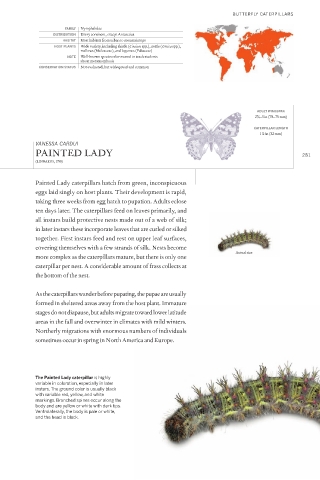
            The Painted Lady caterpillar is highly
            variable in coloration, especially in later
            instars. The ground color is usually black
            with variable red, yellow, and white
            markings. Branched spines occur along the
            body and are yellow or white with dark tips.
            Ventrolaterally, the body is pale or white,
            and the head is black.

