


Page 285 - The Book of Caterpillars: A Life-Size Guide to Six Hundred Species From Around the World
P. 285
BUTTERFLY CATERPILLARS

                      FAMILY  Nymphalidae
                  DISTRIBUTION  Eastern Indonesia, Papua New Guinea, Australia,
                           and the Solomon Islands
                     HABITAT  Lowland rain forests and monsoon forests

                  HOST PLANTS  Passion vine (Adenia heterophylla, Passi ora aurantia,
                           and Hollrungia spp.)
                      NOTE  Extremely fast-moving and active caterpillar
             CONSERVATION STATUS  Not evaluated, but not uncommon


                                                                                   ADULT WINGSPAN
                                                                                  3–3¼ in (75–82 mm)
                                                                                  CATERPILLAR LENGTH
                                                                                    1 ⁄   in (40 mm)
            VINDULA ARSINOE
            CRUISER                                                                              283

            (CRAMER, [1777])


            Cruiser caterpillars hatch from eggs laid by the female

            butter y on the tendrils of the food plant. In the early instars,
            the caterpillar rests on the tendril during the day and feeds
            on the nearby leaves during the night. Later instars rest on leaves
            during non-feeding periods. The caterpillars are very active and
            sensitive to touch, often dropping to the ground if disturbed.

            Unlike those of other passion vine-feeding butter ies, in this
            species the larvae are usually solitary. The larval stage lasts about
            16 days in the wet season and 25 days in the winter dry season.


            Pupation takes place with the pupa attached to a silken pad
            on the stem of the food plant and suspended head down from
            the cremaster. The pupa resembles a dead leaf and twitches if
            disturbed, an action that probably provides some protection
            from parasitoids and predators. The adults  y in patchy sunlight


            and shady areas in rain forests and have a gliding  ght.          Actual size


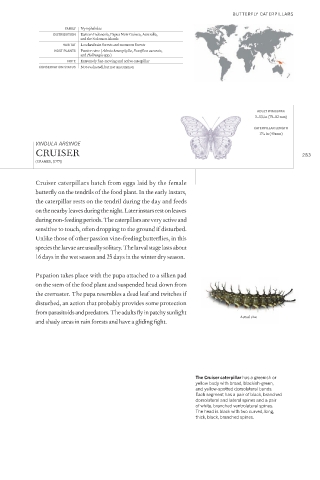
                                                               The Cruiser caterpillar has a greenish or
                                                               yellow body with broad, blackish-green,
                                                               and yellow-spotted dorsolateral bands.
                                                               Each segment has a pair of black, branched
                                                               dorsolateral and lateral spines and a pair
                                                               of white, branched ventrolateral spines.
                                                               The head is black with two curved, long,
                                                               thick, black, branched spines.

