


Page 290 - The Book of Caterpillars: A Life-Size Guide to Six Hundred Species From Around the World
P. 290
MOTH CATERPILLARS

                                                     FAMILY  Yponomeutidae
                                                 DISTRIBUTION
                                                 DISTRIBUTION
                                                 DIS TRIBUTION  Europe, Siberia, India, and eastern Asia to Japan
                                                    HABIT
                                                    HABITAT
                                                    HABITAT T  Woodlands, hedgerows, parks, and gardens
                                                       A
                                                  HOS
                                                    T PLANT
                                                  HOST PLANTS S  Bird Cherry (Prunus padus)
                                                  HOST PLANTS
                                                      NO
                                                      NOTE  Small, gregarious caterpillar that can defoliate whole trees
                                                      NOTE
                                                       TE
                                                      TUS
                                             CONSERV
                                                      A
                                                 A
                                             CONSERVATION STATUS
                                             CONSERVATION STATUS  Not evaluated, but widespread and common
                                                     T
                                                  TION S
            ADULT WINGSPAN
            ⅝–1 in (16–25 mm)
           CATERPILLAR LENGTH
             ¾ in (19 mm)
                                                                     YPONOMEUTA EVONYMELLUS
                                            BIRD-CHERRY ERMINE MOTH
    288
                                                                                   (LINNAEUS, 1758)
                                            Bird-cherry Ermine Moth caterpillars hatch from eggs laid
                                            on the host plant and develop slowly, overwintering there and
                                            becoming active again the following spring, when they spin
                                            huge, communal, silken webs over branches of the host tree,
                                            giving it a frost-like covering. The gregarious caterpillars feed
                                            on the leaves beneath it, the web giving them protection from
                       Actual size
                                            predators. They also pupate in the trees, spinning white, opaque
                                            cocoons that are suspended within the web.


                                            The small, day-flying adults emerge and fly in late summer.
                                            While the caterpillars can reach pest proportions, defoliating
                                            many trees, in the past their silken webs were put to a unique
                                            artistic use. In the sixteenth century, in the Austrian Tyrol,
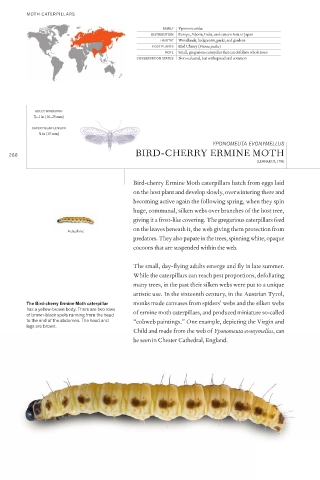
         The Bird-cherry Ermine Moth caterpillar   monks made canvases from spiders’ webs and the silken webs
         has a yellow-brown body. There are two rows   of ermine moth caterpillars, and produced miniature so-called
         of brown-black spots running from the head
         to the end of the abdomen. The head and   “cobweb paintings.” One example, depicting the Virgin and
         legs are brown.
                                            Child and made from the web of Yponomeuta evonymellus, can
                                            be seen in Chester Cathedral, England.

