


Page 292 - The Book of Caterpillars: A Life-Size Guide to Six Hundred Species From Around the World
P. 292
MOTH CATERPILLARS

                                                     FAMILY  Elachistidae
                                                 DISTRIBUTION  Most of Europe, east to the Urals and Iran, northeastern
                                                          United States, and eastern Canada (introduced in the 1960s
                                                          and slowly spreading)
                                                    HABITAT  Open, disturbed, calcareous or sandy places
                                                  HOST PLANTS  Viper’s Bugloss (Echium vulgare) and other Echium spp., including
                                                          E. tuberculatum; also Hound’s Tongue (Cynoglossum o   cinale),
                                                          alkanet (Anchusa spp.), and gromwell (Lithospermum spp.)
                                                      NOTE  Caterpillar that wriggles vigorously when disturbed—behavior
                                                          typical of microlarvae
                                             CONSERVATION STATUS  Not evaluated, but widespread in suitable habitat throughout
                                                          most of its range


            ADULT WINGSPAN
           ¾–1⅛ in (20–28 mm)
           CATERPILLAR LENGTH
             ¾ in (20 mm)
                                                                          ETHMIA BIPUNCTELLA
                                                     VIPER’S BUGLOSS MOTH
    290
                                                                                   (FABRICIUS, 1775)


                                            The Viper’s Bugloss Moth caterpillar lives among the  owers
                                            or leaves of its food plant, sheltering under a slight web. When
                                            disturbed, like many “micromoth” larvae, it wriggles vigorously
                                            backward. The eggs are laid singly on the underside of leaves,
                                            hatching after about ten days. There are two broods annually,
                                            and the caterpillar can be found in June and July, then again in
                      Actual size
                                            September. It leaves the food plant to pupate in a cocoon among
                                            leaf litter on the ground and passes the winter as a pupa.


                                            The black-and-white patterned adults fly in the spring and
                                            again in the late summer. The species is a member of the

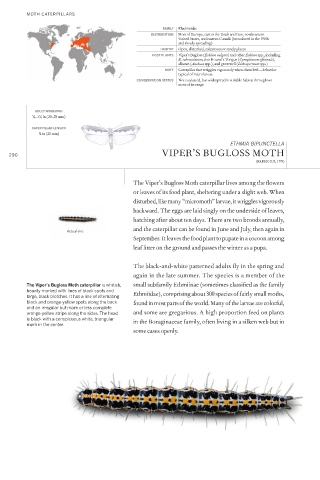
          The Viper’s Bugloss Moth caterpillar is whitish,   small subfamily Ethmiinae (sometimes classi ed as the family
          heavily marked with lines of black spots and   Ethmiidae), comprising about 300 species of fairly small moths,
          large, black blotches. It has a line of alternating
          black and orange-yellow spots along the back   found in most parts of the world. Many of the larvae are colorful,
          and an irregular but more or less complete
          orange-yellow stripe along the sides. The head   and some are gregarious. A high proportion feed on plants
          is black with a conspicuous white, triangular   in the Boraginaceae family, often living in a silken web but in
          mark in the center.
                                            some cases openly.

