


Page 284 - The Book of Caterpillars: A Life-Size Guide to Six Hundred Species From Around the World
P. 284
BUTTERFLY CATERPILLARS

                                                     FAMILY  Nymphalidae
                                                 DISTRIBUTION  Most of United States
                                                    HABITAT  Fields, parks, gardens, and canyons
                                                  HOST PLANTS  Pearly Everlasting (Anaphalis margaritaceae), cudweed
                                                          (Gnaphalium spp.), and pussytoe (Antennaria spp.)
                                                      NOTE  Spiny caterpillar that builds complex silk nests
                                             CONSERVATION STATUS  Not evaluated, but common


            ADULT WINGSPAN
           2–2⅛ in (50–55 mm)
           CATERPILLAR LENGTH
           1½–1  ⁄   in (38–43 mm)
                                                                          VANESSA VIRGINIENSIS
                                                                AMERICAN LADY
    282
                                                                                     (DRURY, 1773)


                                            American Lady females lay eggs singly or a few at a time on
                                            their low-growing host plants. The eggs hatch after six to
                                            seven days, and  rst instars immediately excavate lightly silked


                                            nests under leaf pubescence. Most  rst instar caterpillars stay
                                            between leaf membranes, feeding and creating “windowpane”
                                            areas. Older instars move to the outer leaf surface and
                                            form increasingly complex nests by silking leaves together.
                                            Feeding occurs inside or outside the nests, mostly by night.
                                            Final ( fth) instar caterpillars leave their nests and rest exposed

                                            on stems and leaves.


                                            The caterpillar’s defense is based mostly on concealment
                                            in nests until the  fth instar, when prominent spines and bold

                                            color patterns may deter predators. Pupation occurs mainly on
                                            the host plant and lasts for less than a week. Development from
                       Actual size
                                            egg-laying to adult eclosion takes about a month during summer.

                                            Adults  y fast and erratically, usually close to the ground, and

                                            visit numerous types of  owers for nectar.


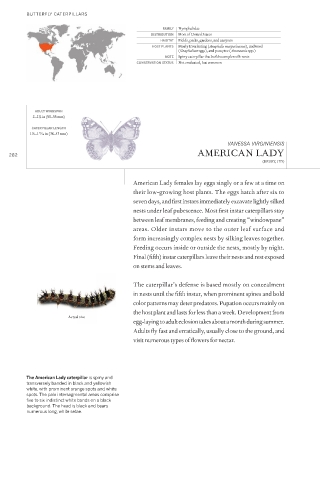
         The American Lady caterpillar is spiny and
         transversely banded in black and yellowish
         white, with prominent orange spots and white
         spots. The pale intersegmental areas comprise
           ve to six indistinct white bands on a black
         background. The head is black and bears
         numerous long, white setae.

