


Page 294 - The Book of Caterpillars: A Life-Size Guide to Six Hundred Species From Around the World
P. 294
MOTH CATERPILLARS

                                                     FAMILY  Pterophoridae
                                                 DISTRIBUTION
                                                 DISTRIBUTION  Europe
                                                   TRIBUTION
                                                 DIS
                                                    HABIT
                                                    HABITAT
                                                    HABITAT T  Grasslands, sand dunes, and shingle
                                                       A
                                                    T PLANT
                                                  HOST PLANTS
                                                  HOST PLANTS S  Restharrow (Ononis spp.)
                                                  HOS

                                                      NOTE
                                                      NOTE
                                                      NO TE  Green caterpillar that is well camou aged on its food plant
                                                      A
                                                 A
                                             CONSERV
                                                  TION S
                                                     T
                                                      TUS
                                             CONSERVATION STATUS
                                             CONSERVATION STATUS  Not evaluated, but locally rare
            ADULT WINGSPAN
             ⁄  –⅞ in (18–22 mm)
           CATERPILLAR LENGTH
            ¼–
⁄   in (6–8 mm)
                                                                   MARASMARCHA LUNAEDACTYLA
                                                               CRESCENT MOON
    292
                                                                                   (HAWORTH, 1811)
                                            Crescent Moon caterpillars hatch from eggs laid on
                                            restharrows—tough weeds so-named because in the past they
                                            obstructed harrows from breaking up the soil. The emerging
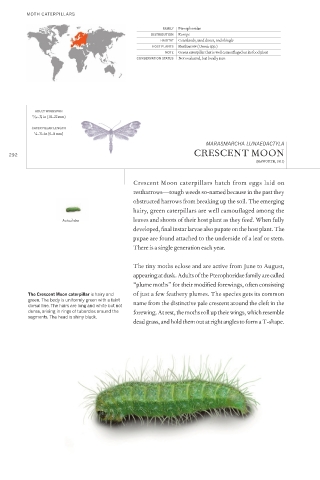
                                            hairy, green caterpillars are well camouflaged among the
                     Actual size            leaves and shoots of their host plant as they feed. When fully

                                            developed,  nal instar larvae also pupate on the host plant. The
                                            pupae are found attached to the underside of a leaf or stem.
                                            There is a single generation each year.


                                            The tiny moths eclose and are active from June to August,
                                            appearing at dusk. Adults of the Pterophoridae family are called

                                            “plume moths” for their modi ed forewings, often consisting
          The Crescent Moon caterpillar is hairy and   of just a few feathery plumes. The species gets its common
          green. The body is uniformly green with a faint   name from the distinctive pale crescent around the cleft in the
          dorsal line. The hairs are long and white but not
          dense, arising in rings of tubercles around the   forewing. At rest, the moths roll up their wings, which resemble
          segments. The head is shiny black.
                                            dead grass, and hold them out at right angles to form a T-shape.

