


Page 295 - The Book of Caterpillars: A Life-Size Guide to Six Hundred Species From Around the World
P. 295
MOTH CATERPILLARS

                      FAMILY  Tortricidae
                  DISTRIBUTION  Large areas of both northern and southern hemispheres at
                           latitudes between 30 degrees and 60 degrees
                     HABITAT  Horticultural and urban areas where host plants occur
                  HOST PLANTS  Pome fruit (Rosaceae): apple (Malus spp.), pear (Pyrus spp.),
                           and Quince (Cydonia oblonga); occasionally stone fruits: plum and
                           apricot (Prunus spp.) and walnut (Juglans spp.)
                      NOTE  Caterpillar that is a pest of apple and pear orchards
             CONSERVATION STATUS  Not evaluated, but a widespread and common pest species


                                                                                   ADULT WINGSPAN
                                                                                      ⁄   in (17 mm)
                                                                                  CATERPILLAR LENGTH
                                                                                   ⁄  –¾ in (15–19 mm)
            CYDIA POMONELLA
            CODLING MOTH                                                                         293

            (LINNAEUS, 1758)


            Codling Moth caterpillars hatch from eggs laid on the fruit
            surface. They burrow into the fruit and tunnel to the core to feed
            on the seeds. Pupation occurs in a cocoon, usually under bark or
            in crevices of the host tree. There are one to three generations
            a year, with the caterpillar overwintering in a state of diapause.   Actual size
            Day length, temperature, and food quality are the main factors
            in uencing induction of diapause. If the caterpillars hatch under

            short day lengths and cooler weather, when feeding is complete
            they will enter diapause in their cocoon.


            Diapause is broken only after an extended period of cold
            weather—below 50°F (10ºC)—followed by warmer weather,
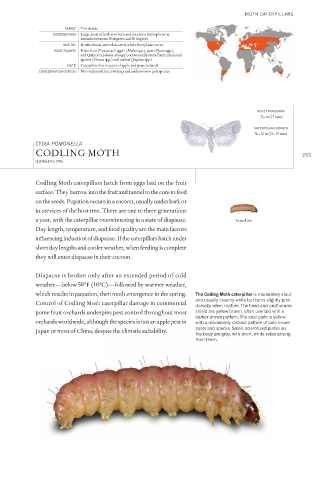
            which results in pupation, then moth emergence in the spring.   The Coding Moth caterpillar is moderately stout
            Control of Codling Moth caterpillar damage in commercial   and usually creamy white but turns slightly pink
                                                               dorsally when mature. The head and prothoracic
            pome fruit orchards underpins pest control throughout most   shield are yellow brown, often overlaid with a
            orchards worldwide, although the species is not an apple pest in   darker brown pattern. The anal plate is yellow
                                                               with a moderately distinct pattern of pale brown
            Japan or most of China, despite the climatic suitability.  spots and specks. Small, sclerotized plates on
                                                               the body are gray, with short, white setae arising
                                                               from them.

