


Page 46 - The Book of Caterpillars: A Life-Size Guide to Six Hundred Species From Around the World
P. 46
BUTTERFLY CATERPILLARS
FAMILY Papilionidae
DISTRIBUTION New Guinea and surrounding islands, far northeastern Australia
HABITAT Rain-forest clearings where host plants are in abundance
HOST PLANTS Pipevine (Aristolochia spp.)
NOTE Voracious caterpillar that is toxic to predators
CONSERVATION STATUS Not evaluated, but widespread; international export is restricted,
as for all Ornithoptera (birdwing) species
ADULT WINGSPAN
4⅞–6 in (125–150 mm)
CATERPILLAR LENGTH
2⁄–2¾ in (65–70 mm)
ORNITHOPTERA PRIAMUS
NEW GUINEA BIRDWING
44
(LINNAEUS, 1758)
Although Ornithoptera priamus is one of the largest butterfly
species in the world, its caterpillar is smaller than you might
expect. This is because the adult’s body is small in relation
to the wings, which are huge, especially in the case of females.
The early instars can be found feeding in small groups but
as they get larger, requiring more food, they venture off on
their own. Since pipevine host plants are toxic, the caterpillar,
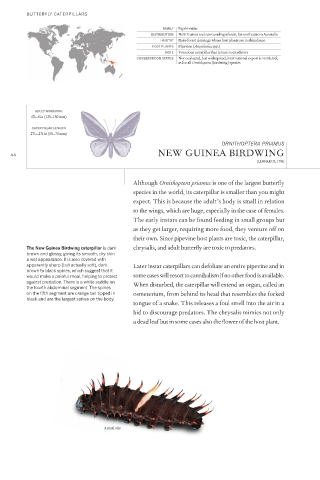
The New Guinea Birdwing caterpillar is dark chrysalis, and adult butterfly are toxic to predators.
brown and glossy, giving its smooth, dry skin
a wet appearance. It is also covered with
apparently sharp (but actually soft), dark Later instar caterpillars can defoliate an entire pipevine and in
brown to black spines, which suggest that it
would make a painful meal, helping to protect some cases will resort to cannibalism if no other food is available.
against predation. There is a white saddle on When disturbed, the caterpillar will extend an organ, called an
the fourth abdominal segment. The spines
on the fth segment are orange tan tipped in osmeterium, from behind its head that resembles the forked
black and are the largest spikes on the body.
tongue of a snake. This releases a foul smell into the air in a
bid to discourage predators. The chrysalis mimics not only
a dead leaf but in some cases also the flower of the host plant.
Actual size

