


Page 48 - The Book of Caterpillars: A Life-Size Guide to Six Hundred Species From Around the World
P. 48
BUTTERFLY CATERPILLARS

                                                     FAMILY  Papilionidae
                                                 DISTRIBUTION  Northern, eastern, and southern Australia, and New Guinea
                                                    HABITAT  Citrus orchards, river valleys, open moist lowland forests,
                                                          and eucalypt woodlands
                                                  HOST PLANTS  Cultivated and native Citrus spp.
                                                      NOTE  Day-feeding caterpillar that is a minor pest of Citrus
                                             CONSERVATION STATUS  Not evaluated, but common


            ADULT WINGSPAN
           4–4¼ in (100–110 mm)
           CATERPILLAR LENGTH
           2⅛–2⁹∕₁₆ in (55–65 mm)
                                                                               PAPILIO AEGEUS
                                                 ORCHARD SWALLOWTAIL
    46
                                                                                    DONOVAN, 1805


                                            Orchard Swallowtail caterpillars hatch from eggs laid singly on
                                            young Citrus shoots a few days earlier. Although the caterpillars

                                            are camouflaged, blending in well with Citrus foliage, they are
                                            frequently parasitized by wasps and flies. To deter predators,

                                            the caterpillars evert their forked, bright red osmeterium, which
                                            emits a Citrus smell. The caterpillars feed diurnally, resting
                                            by night on the upper side of leaves. Development from egg
                                            hatch to pupation takes 24 to 27 days under warm temperatures,
                                            with short day lengths hastening development and inducing
                                            pupal dormancy.


                                            In southern areas of Australia the pupae overwinter, but in
                                            northern areas breeding continues year-round. The Orchard
                                            Swallowtail is a minor pest of young Citrus plants in inland
                                            irrigated areas of New South Wales, Victoria, and South
                                            Australia, and can also defoliate young Citrus plants in home
                                            gardens. Damage is rarely noticed on mature Citrus trees.
                                            A number of subspecies occur in tropical areas north of Australia.


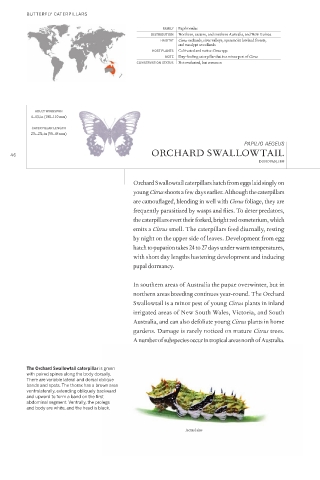
          The Orchard Swallowtail caterpillar is green
          with paired spines along the body dorsally.
          There are variable lateral and dorsal oblique
          bands and spots. The thorax has a brown area
          ventrolaterally, extending obliquely backward
          and upward to form a band on the   rst
          abdominal segment. Ventrally, the prolegs
          and body are white, and the head is black.


                                                            Actual size

