


Page 47 - The Book of Caterpillars: A Life-Size Guide to Six Hundred Species From Around the World
P. 47
BUTTERFLY CATERPILLARS
FAMILY Papilionidae
DIS TRIBUTION Eastern Australia
DISTRIBUTION
DISTRIBUTION
HABITAT
HABITAT
HABIT A T Lowland and upland subtropical rain forests
HOST PLANTS S Birdwing vines (Pararistolochia praevenosa and P. laheyana)
T PLANT
HOST PLANTS
HOS
NO
NOTE
TE
NOTE Caterpillar no longer in decline thanks to host plant renewal
TION S
CONSERV
CONSERVATION STATUS Not evaluated; rated in a report by Environment Australia in
A
T
CONSERVATION STATUS
TUS
A
2002 as not at risk in the south of its range, but of some concern
in northern areas
ADULT WINGSPAN
4⅛–4½ in (105–115 mm)
CATERPILLAR LENGTH
2⁄–2¾ in (58–70 mm)
ORNITHOPTERA RICHMONDIA
RICHMOND BIRDWING 45
(GRAY, [1853])
After hatching, Richmond Birdwing caterpillars consume
their eggshell and then feed on soft leaves, although they will
cannibalize unhatched eggs. There are usually five instars, or six
if nutrient concentrations in the leaves are low. The osmeterium,
found on all instars, produces a volatile odor when the caterpillar
is alarmed, and this is thought to repel predators. One to three
generations are produced annually depending on the altitude
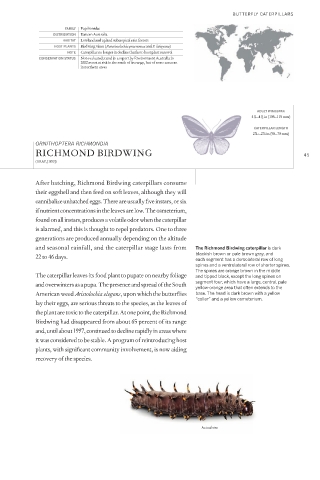
and seasonal rainfall, and the caterpillar stage lasts from The Richmond Birdwing caterpillar is dark
22 to 46 days. blackish brown or pale brown gray, and
each segment has a dorsolateral row of long
spines and a ventrolateral row of shorter spines.
The spines are orange brown in the middle
The caterpillar leaves its food plant to pupate on nearby foliage and tipped black, except the long spines on
and overwinters as a pupa. The presence and spread of the South segment four, which have a large, central, pale
yellow-orange area that often extends to the
American weed Aristolochia elegans, upon which the butterflies base. The head is dark brown with a yellow
lay their eggs, are serious threats to the species, as the leaves of “collar” and a yellow osmeterium.
the plant are toxic to the caterpillar. At one point, the Richmond
Birdwing had disappeared from about 65 percent of its range
and, until about 1997, continued to decline rapidly in areas where
it was considered to be stable. A program of reintroducing host
plants, with significant community involvement, is now aiding
recovery of the species.
Actual size

