


Page 9 - The Book of Caterpillars: A Life-Size Guide to Six Hundred Species From Around the World
P. 9
INTRODUCTION


                                                                                                  7


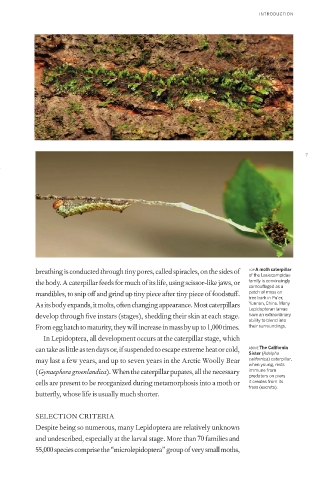
            breathing is conducted through tiny pores, called spiracles, on the sides of   TOP A moth caterpillar
                                                                                of the Lasiocampidae
            the body. A caterpillar feeds for much of its life, using scissor-like jaws, or   family is convincingly
                                                                                camouflaged as a
            mandibles, to snip off and grind up tiny piece after tiny piece of foodstuff.   patch of moss on
                                                                                tree bark in Pu’er,
            As its body expands, it molts, often changing appearance. Most caterpillars   Yunnan, China. Many
                                                                                Lepidopteran larvae
            develop through five instars (stages), shedding their skin at each stage.   have an extraordinary
                                                                                ability to blend into
            From egg hatch to maturity, they will increase in mass by up to 1,000 times.   their surroundings.
               In Lepidoptera, all development occurs at the caterpillar stage, which
            can take as little as ten days or, if suspended to escape extreme heat or cold,   ABOVE The California
                                                                                Sister (Adelpha
            may last a few years, and up to seven years in the Arctic Woolly Bear   californica) caterpillar,
                                                                                when young, rests
            (Gynaephora groenlandica). When the caterpillar pupates, all the necessary   immune from
                                                                                predators on piers
            cells are present to be reorganized during metamorphosis into a moth or   it creates from its
                                                                                frass (excreta).
            butterfly, whose life is usually much shorter.


            SELECTION CRITERIA
            Despite being so numerous, many Lepidoptera are relatively unknown
            and undescribed, especially at the larval stage. More than 70 families and
            55,000 species comprise the “microlepidoptera” group of very small moths,

