


Page 13 - The Book of Caterpillars: A Life-Size Guide to Six Hundred Species From Around the World
P. 13
WHAT IS A CATERPILLAR?


            grub. In most caterpillars, the head

            is conspicuous, although in fami-
            lies such as Lycaenidae it may be
            retracted into the thorax. There are
            six simple, lateral eyes (stemmata)

            to help the caterpillar distinguish
            between dark and light and give it
            some spatial awareness. There is a
            short antenna on each side of the
            mouth, and the mouthparts consist

            of a pair of jaws, or mandibles,                                                       11

            bounded by an upper flap (labrum)
            and lower structure (labium). The
            mandibles swing from side to side,

            “shearing” through vegetation, and
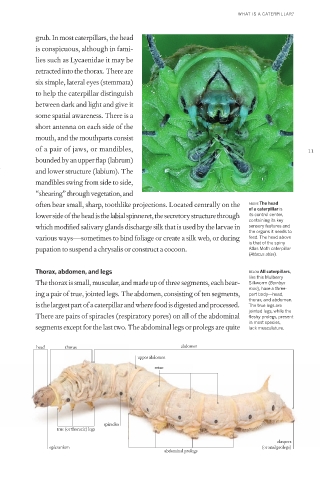
            often bear small, sharp, toothlike projections. Located centrally on the   ABOVE The head
                                                                                of a caterpillar is
            lower side of the head is the labial spinneret, the secretory structure through   its control center,
                                                                                containing its key

            which modified salivary glands discharge silk that is used by the larvae in   sensory features and
                                                                                the organs it needs to
            various ways—sometimes to bind foliage or create a silk web, or during   feed. The head above
                                                                                is that of the spiny
            pupation to suspend a chrysalis or construct a cocoon.              Atlas Moth caterpillar
                                                                                (Attacus atlas).

            Thorax, abdomen, and legs                                           BELOW All caterpillars,
                                                                                like this Mulberry
            The thorax is small, muscular, and made up of three segments, each bear-  Silkworm (Bombyx
                                                                                mori), have a three-
            ing a pair of true, jointed legs. The abdomen, consisting of ten segments,   part body—head,
                                                                                thorax, and abdomen.
            is the largest part of a caterpillar and where food is digested and processed.   The true legs are
                                                                                jointed legs, while the
            There are pairs of spiracles (respiratory pores) on all of the abdominal   fl eshy prolegs, present
                                                                                in most species,
            segments except for the last two. The abdominal legs or prolegs are quite   lack musculature.

             head     thorax                               abdomen
                                             upper abdomen
                                                  setae


                                  spiracles
                   true (or thoracic) legs
                                                                                         claspers
                 epicranium                                                          (or anal prolegs)
                                                     abdominal prolegs

