


Page 12 - The Book of Caterpillars: A Life-Size Guide to Six Hundred Species From Around the World
P. 12
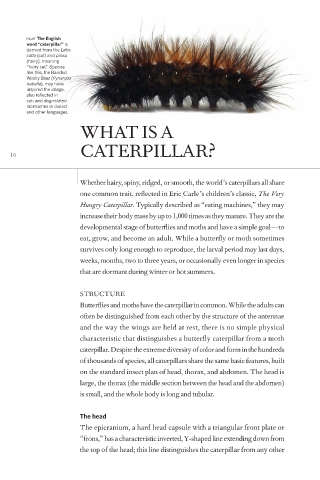
RIGHT The English
          word “caterpillar” is
          derived from the Latin
          catta (cat) and pilosa
          (hairy), meaning
          “hairy cat.” Species
          like this, the Banded
          Woolly Bear (Pyrrarctia
          isabella), may have
          inspired the image,
          also reflected in
          cat- and dog-related
          nicknames in dialect
          and other languages.
                           WHAT IS A


                           CATERPILLAR?

    10


                           Whether hairy, spiny, ridged, or smooth, the world’s caterpillars all share

                           one common trait, reflected in Eric Carle’s children’s classic, The Very
                           Hungry Caterpillar. Typically described as “eating machines,” they may
                           increase their body mass by up to 1,000 times as they mature. They are the
                           developmental stage of butterflies and moths and have a simple goal—to
                           eat, grow, and become an adult. While a butterfly or moth sometimes

                           survives only long enough to reproduce, the larval period may last days,
                           weeks, months, two to three years, or occasionally even longer in species
                           that are dormant during winter or hot summers.


                           STRUCTURE
                           Butterflies and moths have the caterpillar in common. While the adults can
                           often be distinguished from each other by the structure of the antennae
                           and the way the wings are held at rest, there is no simple physical
                           characteristic that distinguishes a butterfly caterpillar from a moth

                           caterpillar. Despite the extreme diversity of color and form in the hundreds
                           of thousands of species, all caterpillars share the same basic features, built
                           on the standard insect plan of head, thorax, and abdomen. The head is
                           large, the thorax (the middle section between the head and the abdomen)

                           is small, and the whole body is long and tubular.


                           The head
                           The epicranium, a hard head capsule with a triangular front plate or
                           “frons,” has a characteristic inverted, Y-shaped line extending down from
                           the top of the head; this line distinguishes the caterpillar from any other

