


Page 11 - The Book of Caterpillars: A Life-Size Guide to Six Hundred Species From Around the World
P. 11
INTRODUCTION


                                                                                                  9


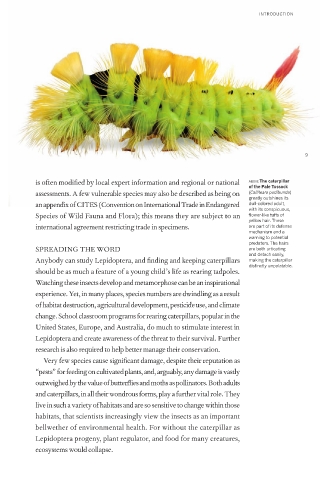
            is often modified by local expert information and regional or national   ABOVE The caterpillar
                                                                                of the Pale Tussock
            assessments. A few vulnerable species may also be described as being on   (Calliteara pudibunda)
                                                                                greatly outshines its
            an appendix of CITES (Convention on International Trade in Endangered   dull-colored adult,
                                                                                with its conspicuous,
            Species of Wild Fauna and Flora); this means they are subject to an   flower-like tufts of
                                                                                yellow hair. These
            international agreement restricting trade in specimens.             are part of its defense
                                                                                mechanism and a
                                                                                warning to potential
                                                                                predators. The hairs
            SPREADING THE WORD                                                  are both urticating
                                                                                and detach easily,
            Anybody can study Lepidoptera, and finding and keeping caterpillars   making the caterpillar
                                                                                distinctly unpalatable.
            should be as much a feature of a young child’s life as rearing tadpoles.
            Watching these insects develop and metamorphose can be an inspirational
            experience. Yet, in many places, species numbers are dwindling as a result

            of habitat destruction, agricultural development, pesticide use, and climate
            change. School classroom programs for rearing caterpillars, popular in the
            United States, Europe, and Australia, do much to stimulate interest in
            Lepidoptera and create awareness of the threat to their survival. Further
            research is also required to help better manage their conservation.

               Very few species cause significant damage, despite their reputation as
            “pests” for feeding on cultivated plants, and, arguably, any damage is vastly
            outweighed by the value of butterflies and moths as pollinators. Both adults
            and caterpillars, in all their wondrous forms, play a further vital role. They

            live in such a variety of habitats and are so sensitive to change within those
            habitats, that scientists increasingly view the insects as an important
            bellwether of environmental health. For without the caterpillar as
            Lepidoptera progeny, plant regulator, and food for many creatures,
            ecosystems would collapse.

