


Page 14 - The Book of Caterpillars: A Life-Size Guide to Six Hundred Species From Around the World
P. 14
WHAT IS A CATERPILLAR?


                           different from the true legs, being fleshy and barrel-shaped, and bearing


                           hooks or crochets at the base. Most caterpillars have four pairs of prolegs
                           on the third to sixth abdominal segments and another pair on combined
                                                    segments nine and ten. Geometridae caterpil-
                                                    lars, however, have only two pairs of prolegs,

                                                    one on the sixth abdominal segment and the
                                                    other on the tenth, producing a characteristic
                                                    walking pattern that has given them the
                                                    nickname of “inchworms” or “loopers.”
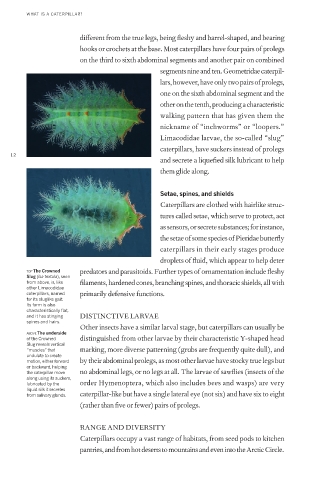
                                                    Limacodidae larvae, the so-called “slug”

                                                    caterpillars, have suckers instead of prolegs
    12

                                                    and secrete a liquefied silk lubricant to help
                                                    them glide along.


                                                    Setae, spines, and shields
                                                    Caterpillars are clothed with hairlike struc-
                                                    tures called setae, which serve to protect, act
                                                    as sensors, or secrete substances; for instance,

                                                    the setae of some species of Pieridae butterfly
                                                    caterpillars in their early stages produce

                                                    droplets of fluid, which appear to help deter


          TOP The Crowned   predators and parasitoids. Further types of ornamentation include fleshy
          Slug (Isa textula), seen

          from above, is, like   filaments, hardened cones, branching spines, and thoracic shields, all with
          other Limacodidae
          caterpillars, named   primarily defensive functions.
          for its sluglike gait.
          Its form is also
          characteristically fl at,
          and it has stinging   DISTINCTIVE LARVAE
          spines and hairs.
                           Other insects have a similar larval stage, but caterpillars can usually be
          ABOVE The underside
          of the Crowned   distinguished from other larvae by their characteristic Y-shaped head
          Slug reveals vertical
          “muscles” that   marking, more diverse patterning (grubs are frequently quite dull), and
          undulate to create
          motion, either forward   by their abdominal prolegs, as most other larvae have stocky true legs but
          or backward, helping

          the caterpillar move   no abdominal legs, or no legs at all. The larvae of sawflies (insects of the
          along using its suckers,
          lubricated by the   order Hymenoptera, which also includes bees and wasps) are very
          liquid silk it secretes
          from salivary glands.  caterpillar-like but have a single lateral eye (not six) and have six to eight
                           (rather than five or fewer) pairs of prolegs.


                           RANGE AND DIVERSITY
                           Caterpillars occupy a vast range of habitats, from seed pods to kitchen
                           pantries, and from hot deserts to mountains and even into the Arctic Circle.

