


Page 16 - (DK) Eyewitness - Mars
P. 16
The Red Planet revealed


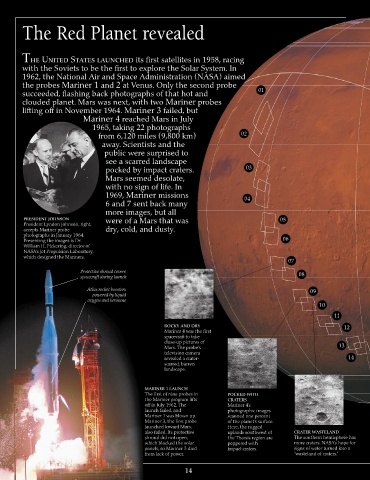
        The United States launched its first satellites in 1958, racing
        with the Soviets to be the first to explore the Solar System. In
        1962, the National Air and Space Administration (NASA) aimed
        the probes Mariner 1 and 2 at Venus. Only the second probe
                                                                                      01
        succeeded, flashing back photographs of that hot and                          l
        clouded planet. Mars was next, with two Mariner probes
        lifting off in November 1964. Mariner 3 failed, but
                             Mariner 4 reached Mars in July
                                1965, taking 22 photographs
                                                                                 02
                                  from 6,120 miles (9,800 km)                   l
                                   away. Scientists and the
                                    public were surprised to
                                    see a scarred landscape
                                                                                  03
                                    pocked by impact craters.                     l
                                    Mars seemed desolate,
                                    with no sign of life. In
                                    1969, Mariner missions                       l
                                                                                  04
                                    6 and 7 sent back many
                                    more images, but all
         PRESIDENT JOHNSON          were of a Mars that was                                  l
                                                                                              05
         President Lyndon Johnson, right,
         accepts Mariner probe      dry, cold, and dusty.
         photographs in January 1964.
                                                                                               06
         Presenting the images is Dr.                                                         l
         William H. Pickering, director of
         NASA’s Jet Propulsion Laboratory,
         which designed the Mariners.
                                                                                                l
                                                                                                07
                            Protective shroud covers                                               l
                                                                                                    08
                            spacecraft during launch
                              Atlas rocket boosters                                                    l
                                                                                                        09
                                powered by liquid
                              oxygen and kerosene
                                                                                                          l
                                                                                                           10
                                                                                                               l
                                                                                                                11
                                                       ROCKY AND DRY                                              l
                                                                                                                   12
                                                       Mariner 4 was the first
                                                       spacecraft to take
                                                       close-up pictures of
                                                                                                                 13
                                                       Mars. The probe’s                                        l
                                                       television camera
                                                                                                                    14
                                                       revealed a crater-                                          l
                                                       scarred, barren
                                                       landscape.
                                                 MARINER 1 LAUNCH
                                                 The first of nine probes in   POCKED WITH
                                                 the Mariner program lifts   CRATERS
                                                 off in July 1962. The      Mariner 4’s
                                                 launch failed, and         photographic images
                                                 Mariner 1 was blown up.    scanned one percent
                                                 Mariner 3, the first probe   of the planet’s surface.
                                                 launched toward Mars,      Here, the rugged
                                                 also failed. Its protective   uplands southwest of   CRATER WASTELAND
                                                 shroud did not open,       the Tharsis region are   The southern hemisphere has
                                                 which blocked the solar    peppered with         more craters. NASA’s hope for
                                                 panels, so Mariner 3 died   impact craters.      signs of water turned into a
                                                 from lack of power.                              “wasteland of craters.”

                                                              14

