


Page 38 - (DK) Eyewitness - Mars
P. 38
Canyons on Mars


        The Solar System’s longest canyon network slashes 2,500
        miles (4,023 km) from east to west across the surface of Mars.
        This great system of cracks and rifts is Valles Marineris—400 miles
        (644 km) at its widest, and four miles (7 km) down at its deepest.
        These canyons were formed by volcanic stresses on the Tharsis
        plateau region, where hot lava flowed, cooled, and then cracked.                          (A) Volcanic era
        “Marsquakes” also opened the crust of the planet and deepened
        rifts and valleys. Water might once have flowed through Martian
        canyons, which now are swept by wind and dust. At the western
        end of Valles Marineris is Noctis Labyrinthus, a complex pattern
        of smaller fractures leading in every direction, like a maze—
        another name for a labyrinth.


                                                                                                (B) Permafrost exposed
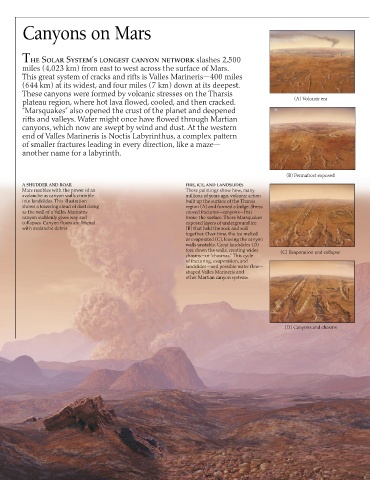
        A SHUDDER AND ROAR                                    FIRE, ICE, AND LANDSLIDES
        Mars rumbles with the power of an                     These paintings show how, many
        avalanche as canyon walls crumble                     millions of years ago, volcanic action
        into landslides. This illustration                    built up the surface of the Tharsis
        shows a towering cloud of dust rising                 region (A) and formed a bulge. Stress
        as the wall of a Valles Marineris                     caused fractures—canyons—that
        canyon suddenly gives way and                         broke the surface. These Marsquakes
        collapses. Canyon floors are littered                 exposed layers of underground ice
        with avalanche debris.                                (B) that held the rock and soil
                                                              together. Over time, the ice melted
                                                              or evaporated (C), leaving the canyon
                                                              walls unstable. Great landslides (D)
                                                              tore down the walls, creating wider   (C) Evaporation and collapse
                                                              chasms—or “chasmas.” This cycle
                                                              of fracturing, evaporation, and
                                                              landslides—and possible water flow—
                                                              shaped Valles Marineris and
                                                              other Martian canyon systems.


                                                                                               (D) Canyons and chasms

