


Page 37 - (DK) Eyewitness - Mars
P. 37
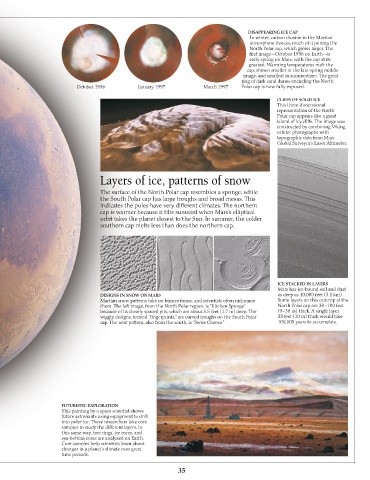
DISAPPEARING ICE CAP
                                                                                    In winter, carbon dioxide in the Martian
                                                                                    atmosphere freezes, much of it joining the
                                                                                    North Polar cap, which grows larger. The
                                                                                    first image—October 1996 on Earth—is
                                                                                    early spring on Mars, with the cap at its
                                                                                   greatest. Warming temperatures melt the
                                                                                   cap, shown smaller in the late-spring middle
                                                                                  image, and smallest in summertime. The great
                                                                                 ring of dark sand dunes encircling the North
                          October 1996         January 1997         March 1997   Polar cap is now fully exposed.

                                                                                             CLIFFS OF SOLID ICE
                                                                                             This three-dimensional
                                                                                             representation of the North
                                                                                             Polar cap appears like a great
                                                                                             island of icy cliffs. The image was
                                                                                             constructed by combining Viking
                                                                                             orbiter photographs with
                                                                                             topographic data from Mars
                                                                                             Global Surveyor’s Laser Altimeter.


                                  Layers of ice, patterns of snow

                                  The surface of the North Polar cap resembles a sponge, while
                                  the South Polar cap has large troughs and broad mesas. This
                                  indicates the poles have very different climates. The northern
                                  cap is warmer because it tilts sunward when Mars’s elliptical
                                  orbit takes the planet closest to the Sun. In summer, the colder
                                  southern cap melts less than does the northern cap.


                                                                                             ICE STACKED IN LAYERS
                                                                                             Mars has ice-bound soil and dust
                                  DESIGNS IN SNOW ON MARS                                    as deep as 10,000 feet (3.1 km).
                                  Martian snow patterns take on bizarre forms, and scientists often nickname   Some layers on this outcrop at the
                                  them. The left image, from the North Polar region, is “Kitchen Sponge”   North Polar cap are 30–100 feet
                                  because of its closely spaced pits, which are about 5.5 feet (1.7 m) deep. The   (9–30 m) thick. A single layer
                                  wiggly designs, termed “fingerprints,” are curved troughs on the South Polar   33 feet (10 m) thick would take
                                  cap. The next pattern, also from the south, is “Swiss Cheese.”  100,000 years to accumulate.


                     FUTURISTIC EXPLORATION
                     This painting by a space scientist shows
                     future astronauts using equipment to drill
                     into polar ice. These researchers take core
                     samples to study the different layers. In
                     this same way, tree rings, ice cores, and
                     sea-bottom cores are analyzed on Earth.
                     Core samples help scientists learn about
                     changes in a planet’s climate over great
                     time periods.

                                                            35

