


Page 59 - (DK) Eyewitness - Mars
P. 59
Dark blue areas show        Light blue areas
      carbon dioxide ice          show water ice
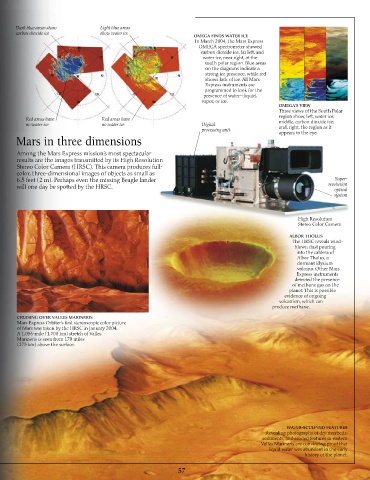
                                                                 OMEGA FINDS WATER ICE
                                                                  In March 2004, the Mars Express
                           -84                      -84            OMEGA spectrometer showed
                           0                        0               carbon dioxide ice, far left, and
                    -45           45         -45         45         water ice, near right, at the
                                                                     south polar region. Blue areas
                           -87                      -87
                                                                     on the diagrams indicate a
                  -90     -90     90       -90              90       strong ice presence, while red
                                                    -90              shows lack of ice. All Mars
                                                                     Express instruments are
                                                                     programmed to look for the
                    -135        135          -135        135        presence of water—liquid,
                          180                      180              vapor, or ice.
                                                                                             OMEGA’S VIEW
                                                                                             Three views of the South Polar
                                                                                             region show, left, water ice;
          Red areas have           Red areas have                                            middle, carbon dioxide ice;
          no water ice             no water ice                     Digital                  and, right, the region as it
                                                                    processing unit          appears to the eye.
      Mars in three dimensions

       Among the Mars Express mission’s most spectacular
       results are the images transmitted by its High Resolution
       Stereo Color Camera (HRSC). This camera produces full-
       color, three-dimensional images of objects as small as
       6.5 feet (2 m). Perhaps even the missing Beagle lander                                                   Super-
       will one day be spotted by the HRSC.                                                                   resolution
                                                                                                                optical
                                                                                                                system


                                                                                                    High Resolution
                                                                                                    Stereo Color Camera
                                                                                                 ALBOR THOLUS
                                                                                                  The HRSC reveals wind-
                                                                                                   blown dust pouring
                                                                                                   into the caldera of
                                                                                                   Albor Tholus, a
                                                                                                   dormant Elysium
                                                                                                   volcano. Other Mars
                                                                                                   Express instruments
                                                                                                   detected the presence
                                                                                                  of methane gas on the
                                                                                                 planet. This is possible
                                                                                               evidence of ongoing
                                                                                             volcanism, which can
                                                                                           produce methane.
       CRUISING OVER VALLES MARINERIS
       Mars Express Orbiter’s first stereoscopic color picture
       of Mars was taken by the HRSC in January 2004.
       A 1,056-mile (1,700 km) stretch of Valles
       Marineris is seen from 170 miles
       (275 km) above the surface.


                                                                                                WATER-SCULPTED FEATURES
                                                                                         Revealing photographs of dry riverbeds,
                                                                                        sediments, and eroded features in eastern
                                                                                       Valles Marineris are convincing proof that
                                                                                          liquid water was abundant in the early
                                                                                                      history of the planet.

                                                            5

