


Page 58 - (DK) Eyewitness - Mars
P. 58
Europe’s Mars Express


        The European Space Agency (ESA) launched its first
        Mars mission in June 2003. Mars Express lifted off
        from Kazakhstan’s Baikonur Cosmodrome on a
        Russian Soyuz/Fregat launcher. The spacecraft
        consisted of an orbiter and a lander. The lander,
        Beagle 2, had objectives that included high-resolution
        photography, mineralogical mapping, and study of
        the atmosphere. Beagle 2 was to study geology and
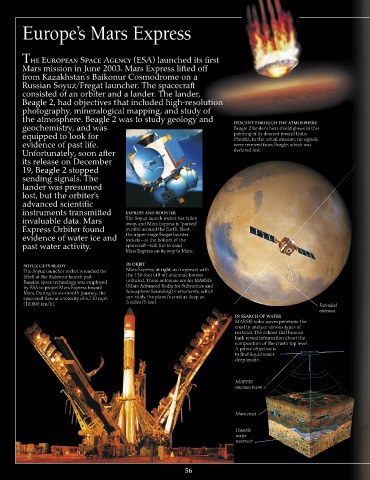
        geochemistry, and was                                                 DESCENT THROUGH THE ATMOSPHERE
                                                                              Beagle 2 lander’s heat shield glows in this
        equipped to look for                                                  painting of its descent toward Isidis
                                                                              Planitia. In the actual mission, no signals
        evidence of past life.                                                were received from Beagle, which was
        Unfortunately, soon after                                             declared lost.
        its release on December
        19, Beagle 2 stopped
        sending signals. The
        lander was presumed
        lost, but the orbiter’s
        advanced scientific
        instruments transmitted            EXPRESS AND BOOSTER
        invaluable data. Mars              The Soyuz launch rocket has fallen
                                           away, and Mars Express is “parked”
        Express Orbiter found              in orbit around the Earth. Next,
        evidence of water ice and          the upper-stage Fregat booster
                                           rockets—at the bottom of the
        past water activity.               spacecraft—will fire to send
                                           Mars Express on its way to Mars.

         SOYUZ GETS READY                  IN ORBIT
         The Soyuz launcher rocket is readied for   Mars Express, at right, as it appears with
         liftoff at the Baikonur launch pad.   the 130-foot (40 m) antennae booms
         Russian space technology was employed   unfurled. These antennae are for MARSIS
         by ESA to propel Mars Express toward   (Mars Advanced Radar for Subsurface and
         Mars. During its six-month journey, the   Ionosphere Sounding) instruments, which
         spacecraft flew at a velocity of 6,710 mph   can study the planet’s crust as deep as
         (10,800 km/h).                    3 miles (5 km).                                                 Extended
                                                                                                           antenna
                                                                               IN SEARCH OF WATER
                                                                               MARSIS radar waves penetrate the
                                                                               crust to analyze various types of
                                                                               material. The echoes that bounce
                                                                               back reveal information about the
                                                                               composition of the crust’s top level.
                                                                               A prime objective is
                                                                               to find liquid water
                                                                               deep inside.


                                                                               MARSIS
                                                                               antenna boom


                                                                               Mars crust

                                                                               Possible
                                                                               water
                                                                               reservoir


                                                              5

