


Page 66 - (DK) Eyewitness - Mars
P. 66
Did you know?


                                            FASCINATING FACTS


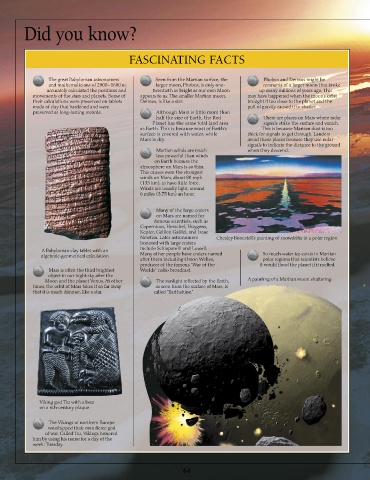
                 The great Babylonian astronomers    Seen from the Martian surface, the   Phobos and Deimos might be
                 and mathematicians of 2000–1600 bc   larger moon, Phobos, is only one-  remnants of a larger moon that broke
                 accurately calculated the positions and   twentieth as bright as our own Moon   up many millions of years ago. This
            movements of the stars and planets. Some of   appears to us. The smaller Martian moon,   may have happened when the moon’s orbit
            their calculations were preserved on tablets   Deimos, is like a star.  brought it too close to the planet and the
            made of clay that hardened and were                                    pull of gravity caused it to shatter.
            preserved as long-lasting records.       Although Mars is little more than
                                                     half the size of Earth, the Red    There are places on Mars where radar
                                                    Planet has the same total land area   signals strike the surface and vanish.
                                               as Earth. This is because most of Earth’s   This is because Martian dust is too
                                               surface is covered with water, while   thick for signals to get through. Landers
                                               Mars is dry.                        avoid these places because they use radar
                                                                                   signals to indicate the distance to the ground
                                                     Martian winds are much        when they descend.
                                                     less powerful than winds
                                                    on Earth because the
                                               atmosphere on Mars is so thin.
                                               This causes even the strongest
                                               winds on Mars, about 80 mph
                                               (133 km), to have little force.
                                               Winds are usually light, around
                                               6 miles (3.75 km) an hour.

                                                     Many of the large craters
                                                     on Mars are named for
                                                    famous scientists, such as
                                               Copernicus, Herschel, Huygens,
                                               Kepler, Galileo Galilei, and Isaac
                                               Newton. Later astronomers   Chesley Bonestell’s painting of snowdrifts in a polar region
                                               honored with large craters
               A Babylonian clay tablet with an   include Schiaparelli and Lowell.
               algebraic-geometrical calculation  Many other people have craters named   So much water ice exists in Martian
                                               after them including Orson Welles,       polar regions that scientists believe
                                               producer of the famous “War of the      it would flood the planet if it melted.
                 Mars is often the third brightest   Worlds” radio broadcast.
                 object in our night sky after the
                Moon and the planet Venus. At other   The sunlight reflected by the Earth,   A painting of a Martian moon shattering
            times, the orbit of Mars takes it so far away   as seen from the surface of Mars, is
            that it is much dimmer, like a star.    called “Earthshine.”


              Viking god Tiu with a bear
              on a 6th-century plaque

                 The Vikings of northern Europe
                 worshipped their own fierce god
                of war. Called Tiu, Vikings honored
            him by using his name for a day of the
            week: Tuesday.


                                                              64

