


Page 232 - DK Eyewitness: Back Roads Northern and Central Italy (Travel Guide)
P. 232
230 BACK ROADS NORTHERN AND CENTRAL ITALY


                                                       pioneered the use of unusual
                                                       materials such as burlap, pumice and
                                                       tar. His work can be seen in the Palazzo
                                                       Albizzini (open daily) and ex-Seccatoio
                                                       Tabacco (www.fondazioneburri.org).
                                                        Autumn and spring are good times
                                                       to hunt for truffles. Search for the
                                                       elusive tubers with Saverio Bianconi
                                                       (075 851 1591; www.tartufibianconi.it),
                                                       then eat your finds back at his farm.
                                                       ª Take Viale V Veneto southwest, turn
                                                       left under railway, then right on SP106
                                                       to Pietralunga. Park near main square.
                                                       2 Pietralunga
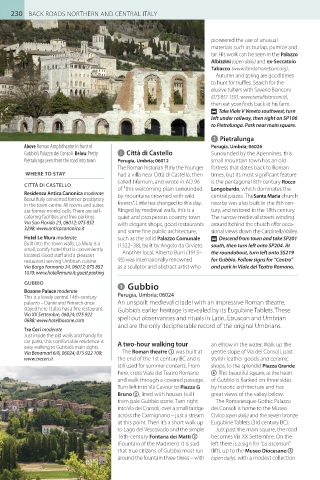
       Above Roman Amphitheatre in front of            Perugia, Umbria; 06026
       Gubbio’s Palazzo dei Consoli  Below Pretty   1 Città di Castello  Surrounded by the Apennines, this
       Pietralunga seen from the road into town  Perugia, Umbria; 06012  small mountain town has an old
                               The Roman historian Pliny the Younger   fortress that dates back to Roman
        WHERE TO STAY          had a villa near Città di Castello, then   times, but its most significant feature
                               called Tifernum, and wrote in AD 96   is the pentagonal 8th-century Rocco
       CITTÀ DI CASTELLO       of "this welcoming plain surrounded   Longobardo, which dominates the
       Residenza Antica Canonica moderate  by mountains crowned with wild   central piazza. TheSanta Maria church
       Beautifully converted former presbytery
       in the town centre. All rooms and suites   forests”. Little has changed to this day.   nearby was also built in the 8th cen-
       are former monks’ cells. There are self-  Ringed by medieval walls, this is a   tury, and restored in the 18th cen tury.
       catering facilities and free parking.    quiet and prosperous country town   The narrow medieval streets winding
       Via San Florido 23, 06012; 075 852   with elegant shops, good restaurants   around behind the church offer occa-
       3298; www.anticacanonica.it
                               and some fine public architecture,   sional views down the Carpinella Valley.
       Hotel Le Mura moderate  such as the solid Palazzo Comunale   ª Descend from town and take SP201
       Built into the town walls, La Mura is a   (1322–38), built by Angelo da Orvieto.  south, then turn left onto SP204. At
       small, comfy hotel that is conveniently
       located. Good staff and a pleasant   Another local, Alberto Burri (1915–  the roundabout, turn left onto SS219
       restaurant serving Umbrian cuisine.    95) was internationally renowned    for Gubbio. Follow signs for “Centro”
       Via Borgo Farinario 24, 06012; 075 852   as a sculptor and abstract artist who   and park in Viale del Teatro Romano.
       1070; www.hotellemura.it; guest parking
       GUBBIO                  3 Gubbio
       Bosone Palace moderate
       This is a lovely central 14th-century   Perugia, Umbria; 06024
       palazzo – Dante and Petrarch once   An unspoilt medieval citadel with an impressive Roman theatre,
       stayed here. It also has a fine restaurant.    Gubbio’s earlier heritage is revealed by its Eugubine Tablets. These
       Via XX Settembre, 06024; 075 922
       0688; www.hotelbosone.com  spell out observances and rituals in Latin, Etruscan and Umbrian
                               and are the only decipherable record of the original Umbrians.
       Tre Ceri moderate
       Just inside the old walls and handy for
       car parks, this comfortable residence is   A two-hour walking tour
       easy walking to Gubbio’s main sights.           an elbow in the water. Walk up the
       Via Benamati 6/8, 06024; 075 922 109;   The Roman theatre 1 was built at   gentle slope of Via dei Consoli, past
       www.treceri.it          the end of the 1st century BC and is   stylish leather goods and ceramic
                               still used for summer concerts. From   shops, to the splendid Piazza Grande
                               here, cross Viale del Teatro Romano   4. This beautiful square, at the heart
                               and walk through a covered passage.   of Gubbio is flanked on three sides
                               Turn left into Via Cavour to Piazza G   by historic architecture and has
                               Bruno 2, lined with houses built   great views of the valley below.
                               from pale Gubbio stone. Turn right   The Romanesque-Gothic Palazzo
                               into Via dei Consoli, over a small bridge   dei Consoli is home to the Museo
                               across the Carmignano – just a stream  Civico (open daily) and the seven bronze
                               at this point. Then it’s a short walk up   Eugubine Tablets (3rd century BC).
                               to Lago del Vescovado and the simple   Just past the main square, the road
                               16th-century Fontana dei Matti 3   becomes Via XX Settembre. On the
                               (Fountain of the Madmen). It is said   left there is a sign for “La ascensori”
                               that true citizens of Gubbio must run   (lift), up to the Museo Diocesano 5
                               around the fountain three times – with  (open daily), with a modest collection


   230-235_Back_Roads_Northern_Italy.indd   230                         06/10/17   2:59 pm
  Back Roads         LAYERS PRINTED:
  Catalogue Spread template   “UK” LAYER
  (OpenType)
  Date 02 November 2009
  Size 145mm x 217mm
  Fonts Bulletfont, Clearbullet,
  Frutiger Pro, Myriad Pro, Travelfont

