


Page 286 - (DK Eyewitness) Travel Guide - Europe
P. 286
284 THE IBERIAN PENINSULA
Central Spain cathedral, aqueduct, and castle
domin ating the skyline, the
Much of Spain’s vast central plateau, the meseta, is covered view of the town from the valley
with wheat fields or dry, dusty plains, but there are many below at sunset is magical.
attractive places to explore. Spain’s largest region, Castilla y Perched on a rocky outcrop
León, has a rich history. It boasts some of the country’s most at the city’s western end is the
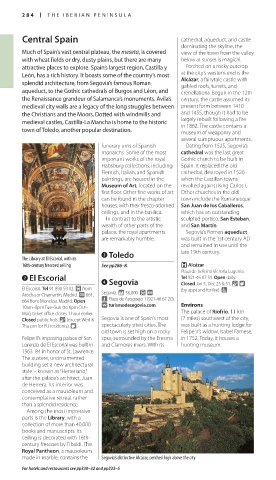
Alcázar, a fairytale castle with
splendid architecture, from Segovia’s famous Roman gabled roofs, turrets, and
aqueduct, to the Gothic cathedrals of Burgos and Léon, and crenellations. Begun in the 12th
the Renaissance grandeur of Salamanca’s monuments. Avila’s century, the castle assumed its
medieval city walls are a legacy of the long struggles between present form between 1410
the Christians and the Moors. Dotted with windmills and and 1455, though it had to be
medieval castles, Castilla-La Mancha is home to the historic largely rebuilt following a fire
in 1862. The castle contains a
town of Toledo, another popular destination. museum of weaponry and
several sumptuous apartments.
funerary urns of Spanish Dating from 1525, Segovia’s
monarchs. Some of the most cathedral was the last great
important works of the royal Gothic church to be built in
Habsburg collections, including Spain. It replaced the old
Flemish, Italian, and Spanish cathedral, destroyed in 1520
paintings, are housed in the when the Castilian towns
Museum of Art, located on the revolted against King Carlos I.
first floor. Other fine works of art Other churches in the old
can be found in the chapter town include the Romanesque
houses, with their fresco-adorned San Juan de los Caballeros,
ceilings, and in the basilica. which has an outstanding
In contrast to the artistic sculpted portico, San Esteban,
wealth of other parts of the and San Martín.
palace, the royal apartments Segovia’s Roman aqueduct
are remarkably humble. was built in the 1st century AD
and remained in use until the
3 Toledo late 19th century.
The Library at El Escorial, with its
16th-century frescoed ceiling See pp286–8. + Alcázar
Plaza de la Reina Victoria Eugenia.
2 El Escorial Tel 921-46 07 59. Open daily.
4 Segovia Closed Jan 5, Dec 25 & 31. & 8
El Escorial. Tel 91-890 59 02. £ from (by appt and for fee). 7
Atocha or Chamartín, Madrid. @ 661, Segovia. * 56,000. £ @
664 from Moncloa, Madrid. Open n Plaza de Azoguejo 1 (921-46 67 20).
10am–8pm Tue–Sun (to 6pm Oct– ∑ turismodesegovia.com Environs
Mar); ticket office closes 1 hour earlier. The palace of Riofrío, 11 km
Closed public hols. & (except Wed & Segovia is one of Spain’s most (7 miles) southwest of the city,
Thu pm for EU residents). 8 spectacularly sited cities. The was built as a hunting lodge for
old town is set high on a rocky Felipe V’s widow, Isabel Farnese,
Felipe II’s imposing palace of San spur, surrounded by the Eresma in 1752. Today, it houses a
Lorenzo de El Escorial was built in and Clamores rivers. With its hunting museum.
1563–84 in honor of St. Lawrence.
The austere, unornamented
building set a new architectural
style – known as “Herreriano,”
after the palace’s architect, Juan
de Herrera. Its interior was
conceived as a mausoleum and
contemplative retreat rather
than a splendid residence.
Among the most impressive
parts is the Library, with a
collection of more than 40,000
books and manuscripts. Its
ceiling is decorated with 16th-
century frescoes by Tibaldi. The
Royal Pantheon, a mausoleum
made in marble, contains the Segovia’s distinctive Alcázar, perched high above the city
For hotels and restaurants see pp330–32 and pp333–5
284-285_EW_Europe.indd 284 14/07/16 10:15 am

