


Page 284 - (DK Eyewitness) Travel Guide - Europe
P. 284
282 THE IBERIAN PENINSULA
example, society, religion, and
communication. One of the
highlights of the museum is
the rare Mayan Códice Tro-
cortesiano (AD 1250–1500)
from Mexico – a hieroglyphic
parchment illustrated with
scenes of everyday life. Also
worth seeing are the Treasure
of the Quimbayas, pre-
Columbian gold and silver
items dating from AD 500–
1000, and the display of
contemporary folk art from
some of Spain’s former
American colonies.
Roman floor mosaic in the Museo Arqueológico Nacional
e Plaza de Toros
q Museo Steps outside the museum’s
Arqueológico entrance lead underground to de las Ventas
Nacional an exact replica of the Altamira Calle Alcalá 237. Tel 91-356 22 00.
caves in Cantabria – complete
q Ventas. Open for bullfights &
Calle Serrano 13. Tel 91-577 79 12. with their Paleolithic paintings. guided visits only. Museo Taurino:
q Serrano, Retiro. @ 1, 9, 19, 51, 74. The earliest engravings and Tel 91-725 18 57. Open 9:30am–
Open 9:30am–8pm (6:30pm Jul & Aug) drawings date back to around 2:30pm Mon–Fri, 10am–1pm Sun.
Tue–Sat, 9:30am–3pm Sun. Closed 18000 BC. The boldly colored 8 daily (687-739 032). 7
main public hols. & (free from 2pm bison paintings date from ∑ las-ventas.com
Sat & Sun). 8 7 ∑ man.mcu.es around 13000 BC.
Las Ventas is undoubtedly one
Founded by Isabel II in 1867, of the most beautiful bullrings
Madrid’s National Archaeo- w Museo de América in Spain. Built in 1929 in Neo-
logical Museum has hundreds Avde los Reyes Católicos 6. Tel 91-549 Mudéjar style, it replaced the
of fascinating exhibits, ranging 26 41. q Moncloa. Open 10am– city’s original bullring, which
from the prehistoric era to the 8:30pm Tue–Sat (Nov–Apr: to 6:30pm), stood near the Puerta de
19th century. 10am–3pm Sun. Closed some public Alcalá. Outside the bullring are
One of the highlights of hols. & (free on Sun). 7 monuments to two famous
the prehistoric section is the ∑ mecd.gob.es/museodeamerica bullfighters: Antonio
exhibition on the ancient Bienvenida and José Cubero.
civilization of El Argar (1800– This fine museum houses a Adjoining the building, the
1100 BC) – an advanced collection of artifacts relating Museo Taurino provides a
agrarian society that flourished to Spain’s colonization of the history of the rituals and contains
in southeast Spain. There is also Americas. Many of the exhibits, bullfighting memorabilia, such
a display of jewelry uncovered which date back to prehistoric as portraits and sculptures of
at the Roman settlement of times, were brought to Europe famous matadors. There is also a
Numantia, near Soria, and a by the early explorers of the display of the tools of the
5th-century BC bust, La Dama New World. The collection is bullfighter’s trade, including
de Elche. arranged thematically, with capes and banderillas – sharp
The museum’s ground floor individual rooms on, for darts used to wound the bull.
is largely devoted to the period
between Roman and Mudéjar
Spain, and contains some
impressive Roman mosaics.
Outstanding pieces from
the Visigothic period include
a collection of 7th-century
gold votive crowns from Toledo
province, known as the Treasure
of Guarrazar.
Also on show are examples
of Andalusian pottery from
the Islamic era and various
Romanesque exhibits, among
them an ivory crucifix carved
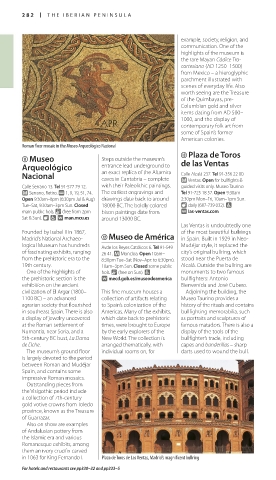
in 1063 for King Fernando I. Plaza de Toros de Las Ventas, Madrid’s magnificent bullring
For hotels and restaurants see pp330–32 and pp333–5
282-283_EW_Europe.indd 282 14/07/16 10:09 am

