


Page 285 - (DK Eyewitness) Travel Guide - Europe
P. 285
M ADRID 283
The Art of Bullfighting
Bullfighting is a sacrificial ritual in which men (and a few women) pit themselves against
an animal bred for the ring. In this “authentic religious drama,” as the poet Federico
García Lorca described it, the spectator experiences the same intensity of fear and
exaltation as the matador. There are three stages, or tercios, in the corrida (bullfight). The
first two, which involve a team of men both on horseback and on foot, are aimed at
progress ively weakening the bull. In the third, the matador moves in for the kill. Despite
opposition on the grounds of cruelty, bullfighting is still very popular. For many Spaniards,
the toreo, the art of bullfighting, is a noble part of their heritage. However, fights today
are often debased by practices designed to disadvantage the bull, in particular shaving
its horns to make them blunt. Bullfighting has been illegal in Catalonia since 2012.
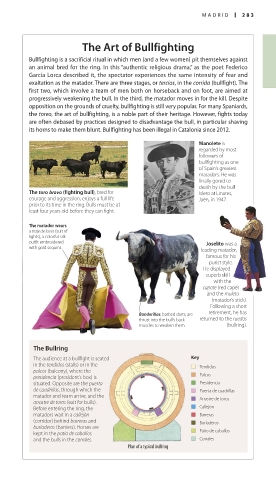
Manolete is
regarded by most
followers of
bullfighting as one
of Spain’s greatest
matadors. He was
finally gored to
death by the bull
The toro bravo (fighting bull), bred for Islero at Linares,
courage and aggression, enjoys a full life Jaén, in 1947.
prior to its time in the ring. Bulls must be at
least four years old before they can fight.
The matador wears
a traje de luces (suit of
lights), a colorful silk
outfit embroidered Joselito was a
with gold sequins.
leading matador,
famous for his
purist style.
He displayed
superb skill
with the
capote (red cape)
and the muleta
(matador’s stick).
Following a short
Banderillas, barbed darts, are retirement, he has
thrust into the bull’s back returned to the ruedos
muscles to weaken them. (bullring).
The Bullring
The audience at a bullfight is seated Key
in the tendidos (stalls) or in the Tendidos
palcos (balcony), where the Palcos
presidencia (president’s box) is
situated. Opposite are the puerta Presidencia
de cuadrillas, through which the Puerta de cuadrillas
matador and team arrive, and the Arrastre de toros
arrastre de toros (exit for bulls).
Before entering the ring, the Callejón
matadors wait in a callejón Barreras
(corridor) behind barreras and Burladeros
burladeros (barriers). Horses are Patio de caballos
kept in the patio de caballos
and the bulls in the corrales. Corrales
Plan of a typical bullring
282-283_EW_Europe.indd 283 14/07/16 10:09 am

