


Page 37 - (DK Eyewitness) Travel Guide - Europe
P. 37
THE HIST OR Y OF EUROPE 35
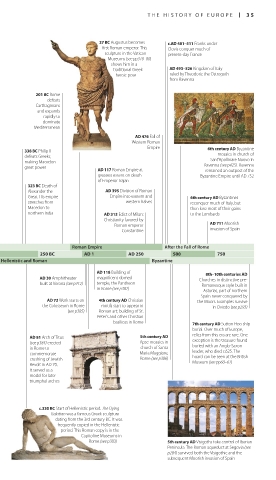
27 BC Augustus becomes c.AD 481–511 Franks under
first Roman emperor. This Clovis conquer much of
sculpture in the Vatican present-day France
Museums (see pp378–80)
shows him in a
traditional Greek AD 493–526 Kingdom of Italy
heroic pose ruled by Theodoric the Ostrogoth
from Ravenna
201 BC Rome
defeats
Carthaginians
and expands
rapidly to
dominate
Mediterranean
AD 476 Fall of
Western Roman
Empire 6th century AD Byzantine
338 BC Philip II
defeats Greeks, mosaics in church of
making Macedon Sant’Apollinare Nuovo in
great power Ravenna (see p425). Ravenna
AD 117 Roman Empire at remained an outpost of the
greatest extent on death Byzantine Empire until AD 752
of Emperor Trajan
323 BC Death of
Alexander the AD 395 Division of Roman
Great. His empire Empire into eastern and 6th century AD Byzantines
stretches from western halves reconquer much of Italy, but
Macedon to then lose most of their gains
northern India AD 313 Edict of Milan: to the Lombards
Christianity favored by
Roman emperor AD 711 Moorish
Constantine invasion of Spain
Classical Greece Roman Empire After the Fall of Rome
250 BC AD 1 AD 250 500 750
Greek and Etruscan Hellenistic and Roman Byzantine
AD 118 Building of 8th–10th centuries AD
AD 30 Amphitheater magnificent domed Churches in distinctive pre-
built at Verona (see p412) temple, the Pantheon Romanesque style built in
in Rome (see p382) Asturias, part of northern
Spain never conquered by
AD 72 Work starts on 4th century AD Christian the Moors. Examples survive
the Colosseum in Rome motifs start to appear in in Oviedo (see p293)
(see p385) Roman art; building of St.
Peter’s and other Christian
basilicas in Rome 7th century AD Sutton Hoo ship
burial. Over much of Europe,
AD 81 Arch of Titus 5th century AD relics from this era are rare. One
(see p384) erected Apse mosaics in exception is the treasure found
in Rome to church of Santa buried with an Anglo-Saxon
commemorate Maria Maggiore, leader, who died c.625. The
crushing of Jewish Rome (see p386) hoard can be seen at the British
Revolt in AD 70. Museum (see pp60–61)
It served as a
model for later
triumphal arches
c.330 BC Start of Hellenistic period. The Dying
Galatian was a famous Greek sculpture
dating from the 3rd century BC. It was
frequently copied in the Hellenistic
period. This Roman copy is in the
Capitoline Museums in
Rome (see p383) 5th century AD Visigoths take control of Iberian
Peninsula. The Roman aqueduct at Segovia (see
p284) survived both the Visigothic and the
subsequent Moorish invasion of Spain
034-035_EW_Europe.indd 35 14/07/16 10:44 am

