


Page 38 - (DK Eyewitness) Travel Guide - Europe
P. 38
36 EUROPE A T A GLANCE
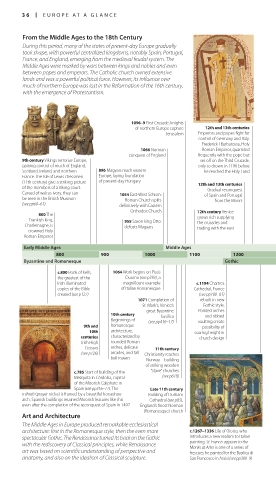
From the Middle Ages to the 18th Century
During this period, many of the states of present-day Europe gradually
took shape, with powerful centralized kingdoms, notably Spain, Portugal,
France, and England, emerging from the medieval feudal system. The
Middle Ages were marked by wars between kings and nobles and even
between popes and emperors. The Catholic church owned extensive
lands and was a powerful political force. However, its influence over
much of northern Europe was lost in the Reformation of the 16th century,
with the emergence of Protestantism.
1096–9 First Crusade; knights
of northern Europe capture 12th and 13th centuries
Jerusalem Emperors and popes fight for
control of Germany and Italy.
Frederick I Barbarossa, Holy
1066 Norman Roman Emperor, quarreled
conquest of England frequently with the pope but
9th century Vikings terrorize Europe, set off on the Third Crusade,
gaining control of much of England, only to drown in 1190 before
Scotland, Ireland, and northern 896 Magyars reach eastern he reached the Holy Land
France. The Isle of Lewis chessmen Europe, laying foundation
(11th century) give a striking picture of present-day Hungary 12th and 13th centuries
of the members of a Viking court. Gradual reconquest
Carved of walrus ivory, they can 1054 East-West Schism: of Spain and Portugal
be seen in the British Museum Roman Church splits from the Moors
(see pp60–61) definitively with Eastern
Orthodox Church 12th century Venice
800 The grows rich supplying
Frankish king, 955 Saxon king Otto the crusades and
Charlemagne, is defeats Magyars trading with the east
crowned Holy
Roman Emperor
Early Middle Ages Middle Ages
800 900 1000 1100 1200
Byzantine and Romanesque Gothic
c.800 Book of Kells, 1064 Work begins on Pisa’s
the greatest of the Duomo (see p393), a
Irish illuminated magnificent example c.1194 Chartres
copies of the Bible of Italian Romanesque Cathedral, France
created (see p127) (see pp180–81)
1071 Completion of rebuilt in new
St. Mark’s, Venice’s Gothic style.
great Byzantine Pointed arches
10th century basilica and ribbed
Beginnings of (see pp416–17) vaulting create
9th and Romanesque possibility of
10th architecture, soaring height in
centuries characterized by church design
Irish High rounded Roman
Crosses arches, delicate 11th century
(see p126) arcades, and tall Christianity reaches
bell towers Norway – building
of striking wooden
c.785 Start of building of the “stave” churches
Mezquita in Córdoba, capital (see p618)
of the Moorish Caliphate in
Spain (see pp316–17). The Late 11th century
mihrab (prayer niche) is framed by a beautiful horseshoe Building of Durham
arch. Spanish buildings retained Moorish features like this Cathedral (see p85),
even after the completion of the reconquest of Spain in 1492 England’s finest Norman
(Romanesque) church
Art and Architecture
The Middle Ages in Europe produced remarkable ecclesiastical
architecture: first in the Romanesque style, then the even more c.1267–1336 Life of Giotto, who
spectacular Gothic. The Renaissance turned its back on the Gothic introduces a new realism to Italian
with the rediscovery of Classical principles, while Renaissance painting. St. Francis appears to the
Monks at Arles is one of a series of
art was based on scientific understanding of perspective and frescoes he painted for the Basilica di
anatomy, and also on the idealism of Classical sculpture. San Francesco in Assisi (see pp388–9)
036-037_EW_Europe.indd 36 14/07/16 10:44 am

