


Page 40 - (DK Eyewitness) Travel Guide - Europe
P. 40
38 EUROPE A T A GLANCE
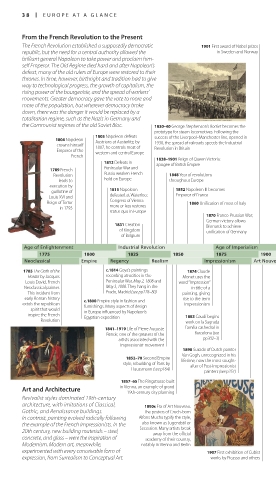
From the French Revolution to the Present
The French Revolution established a supposedly democratic 1901 First award of Nobel prizes
republic, but the need for a central authority allowed the in Sweden and Norway
brilliant general Napoleon to take power and proclaim him-
self Emperor. The Old Regime died hard and after Napoleon’s
defeat, many of the old rulers of Europe were restored to their
thrones. In time, however, birthright and tradition had to give
way to technological progress, the growth of capitalism, the
rising power of the bourgeoisie, and the spread of workers’
movements. Greater democracy gave the vote to more and
more of the population, but wherever democracy broke
down, there was the danger it would be replaced by a
totalitarian regime, such as the Nazis in Germany and
the Communist regimes of the old Soviet Bloc. 1830–40 George Stephenson’s Rocket becomes the
prototype for steam locomotives. Following the
1805 Napoleon defeats success of the Liverpool–Manchester line, opened in
1804 Napoleon Austrians at Austerlitz; by
crowns himself 1807, he controls most of 1930, the spread of railroads speeds the Industrial
Emperor of the western and central Europe Revolution in Britain
French 1838–1901 Reign of Queen Victoria:
1812 Defeats in apogee of British Empire
1789 French Peninsular War and
Revolution Russia weaken French 1848 Year of revolutions
leads to hold on Europe throughout Europe
execution by
guillotine of 1815 Napoleon 1852 Napoleon III becomes
Louis XVI and defeated at Waterloo; Emperor of France
Reign of Terror Congress of Vienna 1860 Unification of most of Italy
in 1793 more or less restores
status quo in Europe
1870 Franco-Prussian War;
German victory allows
1831 Creation Bismarck to achieve
of Kingdom unification of Germany
of Belgium
Age of Enlightenment Industrial Revolution Age of Imperialism
1775 1800 1825 1850 1875 1900
Neoclassical Empire Regency Realism Impressionism Art Nouveau
1785 The Oath of the c.1814 Goya’s paintings 1874 Claude
Horatii by Jacques recording atrocities in the Monet uses the
Louis David, French Peninsular War, May 2, 1808 and word “Impression”
Neoclassical painter. May 3, 1808. They hang in the in title of a
This incident from Prado, Madrid (see pp278–80) painting, giving
early Roman history c.1800 Empire style in fashion and rise to the term
extols the republican furnishings. Many aspects of design Impressionism
spirit that would in Europe influenced by Napoleon’s
inspire the French Egyptian expedition 1883 Gaudí begins
Revolution work on la Sagrada
1841–1919 Life of Pierre Auguste Família cathedral in
Renoir, one of the greatest of the Barcelona (see
artists associated with the pp302–3)
Impressionist movement
1890 Suicide of Dutch painter
Van Gogh, unrecognized in his
1852–70 Second Empire lifetime, now the most sought-
style; rebuilding of Paris by after of Post-Impressionist
Haussmann (see p164)
painters (see p251)
1857–65 The Ringstrasse built
Art and Architecture in Vienna, an example of grand
19th-century city planning
Revivalist styles dominated 19th-century
architecture, with imitations of Classical, 1890s Era of Art Nouveau.
Gothic, and Renaissance buildings. The posters of Czech-born
In contrast, painting evolved radically following Alfons Mucha typify the style,
the example of the French Impressionists. In the also known as Jugendstil or
20th century, new building materials – steel, Secession. Many artists break
away from the official
concrete, and glass – were the inspiration of academy of their country,
Modernism. Modern art, meanwhile, notably in Vienna and Berlin
experimented with every conceivable form of 1907 First exhibition of Cubist
expression, from Surrealism to Conceptual Art. works by Picasso and others
038-039_EW_Europe.indd 38 14/07/16 10:09 am

