


Page 28 - (DK Eyewitness) Travel Guide - Brittany
P. 28
26 INTRODUCING BRIT T AN Y
Religious Architecture
Brittany boasts several abbeys, nine cathe drals, some 20 large
churches, about 100 parish closes and thousands of country
chapels. This rich heritage is proof not only of the strength
of religious faith but also of the skill of local builders. The
golden age of reli gious architecture in Brittany occurred in
the 16th and 17th centuries, when buildings were profusely
deco rated. Porches and rood screens sprouted motifs carved
in oak, limestone or kersanton, a fine-grained granite almost Calvary at Notre-Dame-de
impervious to the passage of time. Tronoën (see p160)
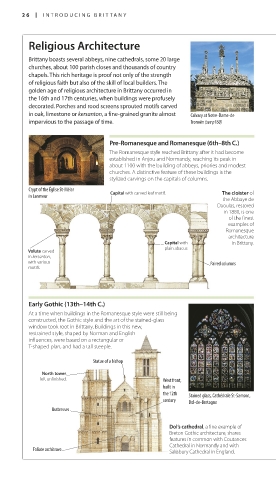
Pre-Romanesque and Romanesque (6th–8th C.)
The Romanesque style reached Brittany after it had become
established in Anjou and Normandy, reaching its peak in
about 1100 with the building of abbeys, priories and mod est
churches. A distinctive feature of these buildings is the
stylized carvings on the capitals of columns.
Crypt of the Église St-Mélar Capital with carved leaf motif.
in Lanmeur The cloister of
the Abbaye de
Daoulas, restored
in 1880, is one
of the finest
examples of
Romanesque
architecture
Capital with in Brittany.
plain abacus
Volute carved
in kersanton,
with various Paired columns
motifs.
Early Gothic (13th–14th C.)
At a time when buildings in the Romanesque style were still being
constructed, the Gothic style and the art of the stained-glass
window took root in Brittany. Buildings in this new,
restrained style, shaped by Norman and English
influences, were based on a rectangular or
T-shaped plan, and had a tall steeple.
Statue of a bishop
North tower,
left unfinished. West front,
built in
the 12th Stained glass, Cathédrale St-Samson,
century Dol-de-Bretagne
Buttresses
Dol’s cathedral, a fine example of
Breton Gothic architecture, shares
fea tures in common with Coutances
Cathedral in Normandy and with
Foliate architrave Salisbury Cathedral in England.
026-027_EW_Brittany.indd 26 11/3/16 1:01 PM

